
When Should You Rent Agriculture Equipment?

As an agricultural worker, you understand the many demanding tasks within your industry. Many farm or ranch operations are time-consuming and require great attention to detail and high levels of efficiency. You also know that reliable equipment is key for unlocking time and money savings, making it crucial to access the equipment you need when you need it.

A common debate for many ranchers and farmers is whether renting is an economical choice to address these needs. Rental equipment offers many advantages, and knowing when and why to rent agricultural machinery can benefit your business.

The Benefits of Renting Equipment

Rental equipment stands out for a variety of reasons:

  • Achieving cost savings: One of the most significant benefits of renting equipment is cost savings. The upfront cost of renting equipment is lower than purchasing a new model, allowing farmers and producers to spend less to access reliable equipment. Additionally, renting can give you more control over spending and resource allocation because you do not need to pay for costs associated with maintenance, repairs or storage. These cost savings can improve your profit margin and allow you to streamline operations for additional profit.
  • Enhancing flexibility: You can scale your operations up or down by renting equipment when needed. Peak seasons may require more workers to meet demand. Rental equipment empowers you to meet this demand while minimizing your cost of ownership.
  • Accessing specialized equipment: Some tasks require specialized equipment, which can be costly. For farms that rarely complete specialized tasks, purchasing equipment may not be economical because the cost of the machine could outweigh the profits you make on your project. Alternatively, rental equipment empowers you to expand specialty services like custom harvesting and enhance efficiency with specialized equipment whenever you need it, while avoiding a long-term commitment.
  • Reducing maintenance responsibilities: Rental equipment providers perform all maintenance and repairs to ensure equipment is in optimal working condition before you rent it. Additionally, if you need repairs or maintenance during the rental period, your provider will administer the necessary services. These reduced responsibilities can lead to even more cost savings while ensuring you always have access to reliable equipment.

Identifying the Right Time to Rent Equipment

Although renting heavy equipment can deliver many benefits, you’ll experience the most success when you choose rentals at crucial times. Check out the top considerations for renting equipment:

1. Financial Constraints

Financial constraints are among the first considerations for agricultural teams considering renting or buying. The lower initial cost of rental equipment makes this option suitable for farms looking to meet demand on a budget. Teams must evaluate what they can afford to determine whether renting is an economical choice. Buying equipment will have a higher initial cost and require you to spend additional funds on maintenance and repairs when necessary.

2. Equipment Availability

In some cases, equipment availability can be the driving factor for rentals. For example, if you’re operating during peak demand seasons and lack the equipment to scale up your operations, you could lose market opportunities and competitive gain. Rentals empower you to meet demand and boost productivity to keep operations moving without a long-term equipment commitment.

You can also rent equipment attachments to increase machine versatility while controlling costs. Renting attachments can increase your flexibility and expand crop diversification while keeping costs even lower.

3. Specific Operational Needs

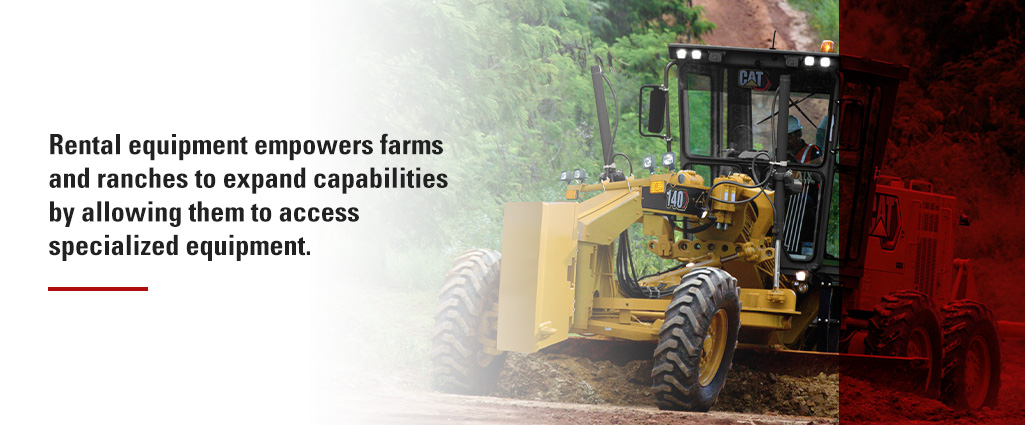
Rental equipment empowers farms and ranches to expand capabilities by allowing them to access specialized equipment. If you’re looking to tackle a demanding project or stand out against competitors, using equipment to meet specific operational needs can make a huge difference. For example, rentals can aid in precision planting, custom harvesting, soil testing and more.

It can also be a significant advantage for small or medium-sized teams looking to compete with larger businesses or corporations. Rentals allow you to access a diverse selection of equipment that can highlight your commitment to yield optimization, customer satisfaction and project efficiency.
4. Updated Equipment Models

Reliable agricultural equipment is crucial for farm and ranch management. New agricultural equipment emerges on the market frequently, and it’s rarely economical to sell existing equipment to purchase the latest models. However, using significantly outdated models can impact your productivity and worker safety. If you have equipment coming to the end of its life or recognize vast differences between your equipment and new models on the market, it may be time to make a change.

Furthermore, rental equipment allows you to try before you buy, empowering you to access the latest technologies, features and controls to make an informed purchasing decision. This strategy ensures you understand the machine you plan to purchase and how it can impact your operations before you take it off the lot.

As a bonus, you can achieve worry-free compliance by opting for rentals. Locations or industries with stringent regulations or environmental standards — including agriculture — often need updated equipment with advanced technologies to maintain compliance. Renting allows you to access updated models so you can drive progress while adhering to local, state or federal guidelines.

5. Project Duration or Scope

Significant or lengthy projects can be suitable for equipment rentals. If you have a large project that needs your attention but you lack the equipment to accommodate it, you could lose out on revenue streams. Renting equipment empowers you to scale operations and ensure laborers have the equipment they need to perform essential tasks.

Additionally, if your existing equipment is inoperable due to repairs, renting equipment may make economic sense to prevent downtime. You can find rental agreements for varying lengths of time, empowering you to control spending while empowering operations.

Find Agriculture Equipment for Rent at Warren CAT

Warren CAT is an authorized Cat® dealer, allowing us to be your one-stop shop for rental equipment in Oklahoma and West Texas. We offer a vast array of agricultural equipment to support farm and ranch operations, and our rentals empower you to embrace innovation at a fraction of the cost. With advanced technology and the latest innovations, our equipment delivers power and efficiency to boost productivity, increase yields and support business growth.

Whether you need a short-term solution for specialized tasks or a long-term rental to meet seasonal demands, we offer flexible rental options to fit your needs and budget. We also proudly offer lease, financing and rent-to-own options, so you can find the most economical choice for your operations.

Browse our catalog of agriculture equipment for sale and rent to find the right model to suit your applications. Have questions? Get in touch by calling us at 866-292-7736.
Linked Sources:

https://www.warrencat.com/news/guide-to-heavy-equipment-rental-costs/
https://www.warrencat.com/news/renting-vs-buying-heavy-equipment/
https://www.warrencat.com/rental/attachments/
https://www.warrencat.com/news/why-you-should-rent-equipment-attachments/
https://www.warrencat.com/news/construction-equipment-in-ranching/
https://www.warrencat.com/rental/
https://www.warrencat.com/technology/
Off-Highway Trucks: Power and Performance in Challenging Terrains

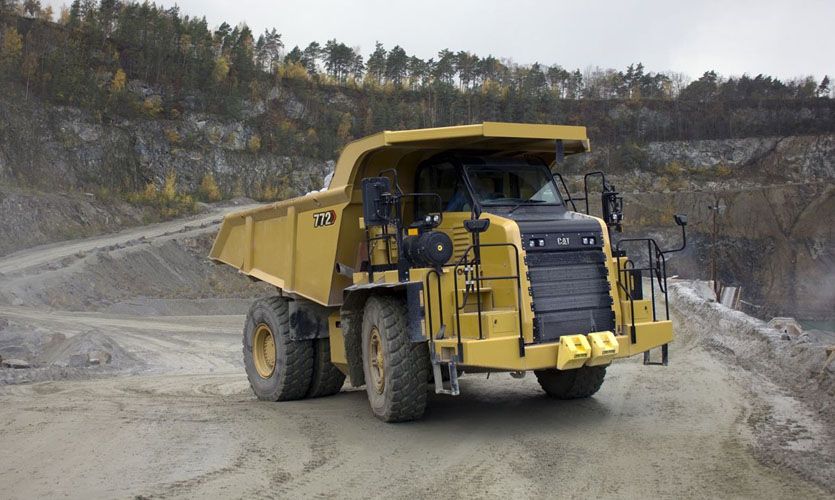
Every project comes with unique obstacles, but projects in challenging terrain demand unique equipment and operational requirements. Off-highway trucks allow teams to navigate rough and uneven terrains to enhance job efficiency. This equipment has immense power capabilities and can aid in several tasks across industries. The specific type of off-road truck and factors like hauling capabilities and available technology will impact which models are most suitable for your application.

How Do Off-Highway Trucks Navigate Challenging Terrain?

Off-road trucks are specialized vehicles capable of safely transporting people, supplies, materials and waste across unique and challenging conditions. Parts and components that aid in navigating challenging terrain include the following:

  • Tire type: All-terrain tires are crucial for ensuring off-road vehicles can navigate surfaces including sand, mud, loose soil and gravel. These robust tires have superior traction to improve operator safety and deep treads help prevent slippage.
  • Ground clearance: Many off-highway trucks have a higher ground clearance than standard vehicles or equipment, allowing them to pass over debris, logs, rocks and other obstacles with ease.
  • Suspension systems: Robust suspension systems allow off-highway trucks to absorb shock and remain stable. These systems enhance operator comfort while making it easy to navigate rough or uneven surfaces.
  • Engines: Off-road trucks have high-torque engines that provide the necessary power to navigate inclines, steep grades and other challenging terrain.
  • Chassis and frame: An off-highway truck’s heavy-duty and durable chassis and frame allow it to withstand stress from heavy loads and challenging terrain.
  • Technology: Advanced technologies, including drive-assistance and terrain monitoring tools, guide truck operation and empower operators to safely navigate various terrain types. These technologies can help the vehicle maintain traction and stability and alert operators of hazardous conditions or operational issues.

What Can You Use Off-Road Trucks for?

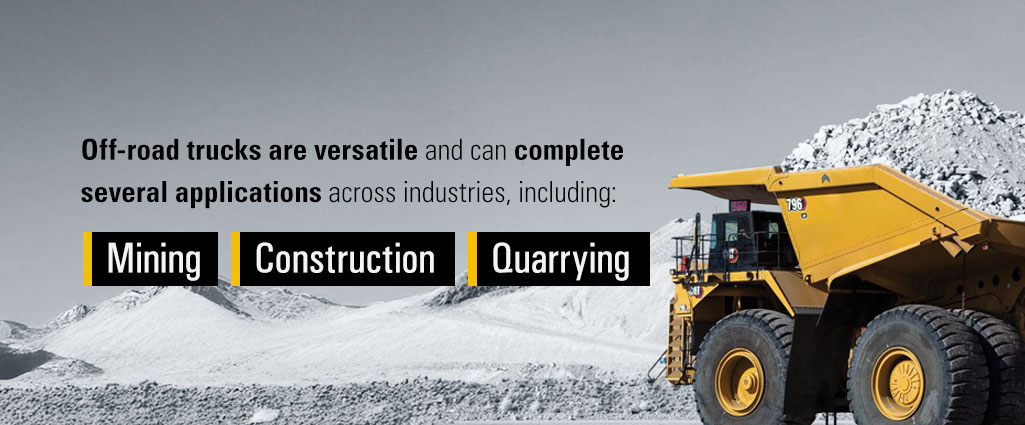
Off-road trucks are versatile and can complete several applications across industries, including:

  • Mining: Mining trucks allow teams to haul materials, such as ore or waste, across challenging terrains, over steep inclines and through hard-to-reach areas. Off-road trucks can also support mining operations by letting teams move supplies and equipment to the jobsite or assist in preparing land for mining operations. These trucks can aid in open-pit operations where teams need to transport materials to processing plants. Some mining teams also use off-highway vehicles to transport explosives necessary for drilling and blasting.
  • Construction: Several types of off-road trucks aid in moving aggregate materials during excavation, grading and land-clearing operations. These trucks can help with site preparation and earthmoving operations, allowing teams to move large volumes efficiently and transport waste or excess materials from the worksite. Off-road trucks can guide utility work involving cable or pipeline installation, and they can transport concrete and similar materials necessary for foundation work.
  • Quarrying: Teams can use off-road trucks to transport extracted aggregate materials and rock from quarry sites to processing areas. This equipment can remove overburden to allow teams to access raw materials and drive material transport and removal for efficient operations. Off-road trucks can also assist in load-out operations when teams must transport finished products like aggregate or crushed stone to delivery points or customers.

What Are the Types of Off-Road Construction Trucks?

The specialization of off-road trucks makes it critical to understand the difference between various types. Each type has unique capabilities. There are several main types of off-highway trucks:

  • Articulated dump trucks (ADTs): ADTs are versatile vehicles that can navigate rough terrains. These trucks offer exceptional maneuverability with a central joint pivot. Articulated trucks are ideal for many construction and mining applications because they can navigate uneven landscapes and tight spaces. These vehicles also have high load capacities and robust construction, making them suitable for moving large materials quantities.
  • Rigid dump trucks (RDTs): RDTs have incredible strength and substantial load capabilities. Teams needing to move large material quantities can rely on these vehicles. These trucks differ from ADTs in the frame — RDTs have a nonarticulated frame, granting exceptional stability.
  • Off-road end dumps: For rapid material unloading, off-road end dumps are a superior choice. Their distinct design allows for precise material placement and fast discharging.
  • Side dump trucks: This type of off-road dump truck has lateral discharge capabilities so teams can spread materials in a controlled manner, such as for road construction applications. Side dump trucks minimize the need for leveling or spreading equipment, boosting efficiency.
  • Water trucks: These off-highway trucks enable teams to transport large amounts of water. They feature oval or round tanks that can hold thousands of gallons of water. These trucks can aid in irrigation tasks, provide fire control, dampen surfaces for dust control, cure concrete, or serve as an emergency water supply.

How to Choose the Right Off-Road Vehicle

Selecting the right off-road truck is vital for ensuring project efficiency. Several factors will impact your decision, including the following:

  • Heavy cargo hauling: Off-road trucks possess unique designs and heavy-duty frames to support heavy or bulky cargo hauling. However, it’s crucial to consider each truck’s carrying capacity and your application needs. Choosing a small capacity can reduce efficiency, but selecting a too-large capacity could result in resource waste. Like other construction equipment, different off-road truck models will offer varying load capacities, so consider your needs and select a compatible vehicle.
  • Specialization: Although each type of off-highway truck can offer solutions for navigating challenging terrains, it’s important to consider truck specialization when choosing a model for your jobsite. For instance, RDTs can offer superior stability for construction teams on uneven terrain, while ADTs may be ideal for tight-space mining applications.
  • Technology: Advanced technology enhances safety, boosts productivity and maximizes operational efficiency. While you can find technology to implement in many trucks, some dealers will offer models with equipped technology. For example, choosing Cat® off-road trucks from Warren CAT gives you access to condition monitoring, fluid analysis and other cutting-edge technologies to drive operations and inform your decisions.
  • Safety considerations: Safety should be the top priority on every jobsite. When browsing models, look for safety systems and features such as stability control, collision avoidance and improved operator visibility.
  • Environmental impact: Many operations requiring off-road trucks take place in ecologically sensitive areas. Additionally, the drive to implement more sustainable practices across industries highlights the importance of finding more fuel-efficient solutions. Consider choosing a provider that offers fuel-efficient technologies and takes other initiatives to reduce environmental impact.

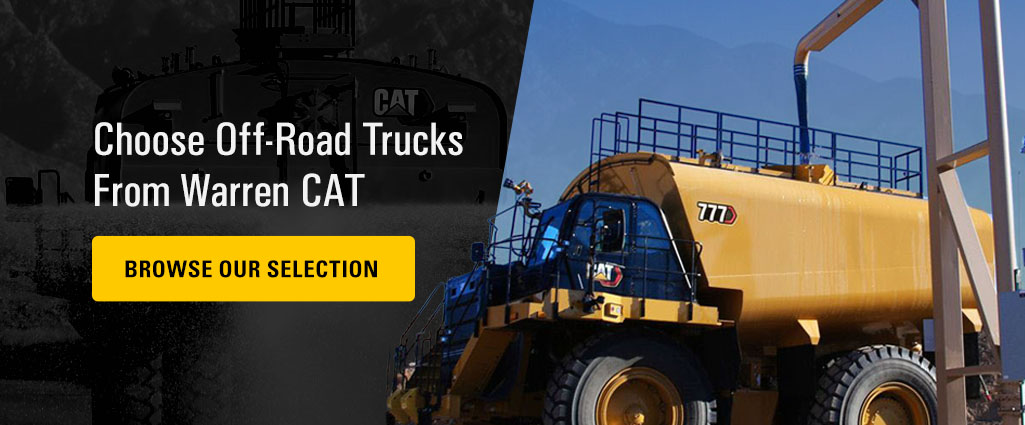
Choose Off-Road Trucks From Warren CAT

Warren CAT is your local Cat dealer in West Texas and Oklahoma. Our team is dedicated to providing quality equipment solutions by offering new and used equipment as well as rental options to meet your needs. When you need an off-road truck, you can rely on our team to help you find the right option to enhance efficiency and productivity. Browse our selection of Cat off-road trucks, or find a dealer near you.

Linked Sources:
https://www.warrencat.com/new-equipment/machines/off-highway-trucks/
https://www.warrencat.com/new-equipment/machines/mining-trucks/
https://www.warrencat.com/new-equipment/machines/off-highway-trucks-off-highway-trucks/
https://www.warrencat.com/rental-equipment/machines/articulated-trucks/
https://www.warrencat.com/new-equipment/machines/water-trucks/
https://www.warrencat.com/technology/condition-monitoring/
https://www.warrencat.com/service/sos-fluid-analysis/
https://www.warrencat.com/technology/
https://www.warrencat.com/locations/