
When Should You Rent Agriculture Equipment?

As an agricultural worker, you understand the many demanding tasks within your industry. Many farm or ranch operations are time-consuming and require great attention to detail and high levels of efficiency. You also know that reliable equipment is key for unlocking time and money savings, making it crucial to access the equipment you need when you need it.

A common debate for many ranchers and farmers is whether renting is an economical choice to address these needs. Rental equipment offers many advantages, and knowing when and why to rent agricultural machinery can benefit your business.

The Benefits of Renting Equipment

Rental equipment stands out for a variety of reasons:

  • Achieving cost savings: One of the most significant benefits of renting equipment is cost savings. The upfront cost of renting equipment is lower than purchasing a new model, allowing farmers and producers to spend less to access reliable equipment. Additionally, renting can give you more control over spending and resource allocation because you do not need to pay for costs associated with maintenance, repairs or storage. These cost savings can improve your profit margin and allow you to streamline operations for additional profit.
  • Enhancing flexibility: You can scale your operations up or down by renting equipment when needed. Peak seasons may require more workers to meet demand. Rental equipment empowers you to meet this demand while minimizing your cost of ownership.
  • Accessing specialized equipment: Some tasks require specialized equipment, which can be costly. For farms that rarely complete specialized tasks, purchasing equipment may not be economical because the cost of the machine could outweigh the profits you make on your project. Alternatively, rental equipment empowers you to expand specialty services like custom harvesting and enhance efficiency with specialized equipment whenever you need it, while avoiding a long-term commitment.
  • Reducing maintenance responsibilities: Rental equipment providers perform all maintenance and repairs to ensure equipment is in optimal working condition before you rent it. Additionally, if you need repairs or maintenance during the rental period, your provider will administer the necessary services. These reduced responsibilities can lead to even more cost savings while ensuring you always have access to reliable equipment.

Identifying the Right Time to Rent Equipment

Although renting heavy equipment can deliver many benefits, you’ll experience the most success when you choose rentals at crucial times. Check out the top considerations for renting equipment:

1. Financial Constraints

Financial constraints are among the first considerations for agricultural teams considering renting or buying. The lower initial cost of rental equipment makes this option suitable for farms looking to meet demand on a budget. Teams must evaluate what they can afford to determine whether renting is an economical choice. Buying equipment will have a higher initial cost and require you to spend additional funds on maintenance and repairs when necessary.

2. Equipment Availability

In some cases, equipment availability can be the driving factor for rentals. For example, if you’re operating during peak demand seasons and lack the equipment to scale up your operations, you could lose market opportunities and competitive gain. Rentals empower you to meet demand and boost productivity to keep operations moving without a long-term equipment commitment.

You can also rent equipment attachments to increase machine versatility while controlling costs. Renting attachments can increase your flexibility and expand crop diversification while keeping costs even lower.

3. Specific Operational Needs

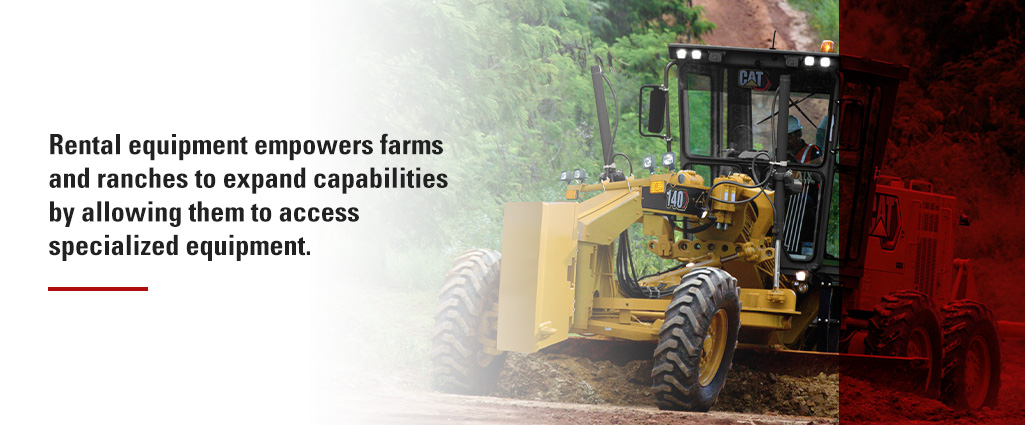
Rental equipment empowers farms and ranches to expand capabilities by allowing them to access specialized equipment. If you’re looking to tackle a demanding project or stand out against competitors, using equipment to meet specific operational needs can make a huge difference. For example, rentals can aid in precision planting, custom harvesting, soil testing and more.

It can also be a significant advantage for small or medium-sized teams looking to compete with larger businesses or corporations. Rentals allow you to access a diverse selection of equipment that can highlight your commitment to yield optimization, customer satisfaction and project efficiency.
4. Updated Equipment Models

Reliable agricultural equipment is crucial for farm and ranch management. New agricultural equipment emerges on the market frequently, and it’s rarely economical to sell existing equipment to purchase the latest models. However, using significantly outdated models can impact your productivity and worker safety. If you have equipment coming to the end of its life or recognize vast differences between your equipment and new models on the market, it may be time to make a change.

Furthermore, rental equipment allows you to try before you buy, empowering you to access the latest technologies, features and controls to make an informed purchasing decision. This strategy ensures you understand the machine you plan to purchase and how it can impact your operations before you take it off the lot.

As a bonus, you can achieve worry-free compliance by opting for rentals. Locations or industries with stringent regulations or environmental standards — including agriculture — often need updated equipment with advanced technologies to maintain compliance. Renting allows you to access updated models so you can drive progress while adhering to local, state or federal guidelines.

5. Project Duration or Scope

Significant or lengthy projects can be suitable for equipment rentals. If you have a large project that needs your attention but you lack the equipment to accommodate it, you could lose out on revenue streams. Renting equipment empowers you to scale operations and ensure laborers have the equipment they need to perform essential tasks.

Additionally, if your existing equipment is inoperable due to repairs, renting equipment may make economic sense to prevent downtime. You can find rental agreements for varying lengths of time, empowering you to control spending while empowering operations.

Find Agriculture Equipment for Rent at Warren CAT

Warren CAT is an authorized Cat® dealer, allowing us to be your one-stop shop for rental equipment in Oklahoma and West Texas. We offer a vast array of agricultural equipment to support farm and ranch operations, and our rentals empower you to embrace innovation at a fraction of the cost. With advanced technology and the latest innovations, our equipment delivers power and efficiency to boost productivity, increase yields and support business growth.

Whether you need a short-term solution for specialized tasks or a long-term rental to meet seasonal demands, we offer flexible rental options to fit your needs and budget. We also proudly offer lease, financing and rent-to-own options, so you can find the most economical choice for your operations.

Browse our catalog of agriculture equipment for sale and rent to find the right model to suit your applications. Have questions? Get in touch by calling us at 866-292-7736.
Linked Sources:

https://www.warrencat.com/news/guide-to-heavy-equipment-rental-costs/
https://www.warrencat.com/news/renting-vs-buying-heavy-equipment/
https://www.warrencat.com/rental/attachments/
https://www.warrencat.com/news/why-you-should-rent-equipment-attachments/
https://www.warrencat.com/news/construction-equipment-in-ranching/
https://www.warrencat.com/rental/
https://www.warrencat.com/technology/

How Heavy Machinery Can Improve Efficiency on Farms and Ranches

With such a vital role in our civilization, farming operations must consistently manage tasks like planting seeds, harvesting crops and tending to livestock to keep our world fed. Manually performing these tasks can be physically and mentally taxing and would not keep up with demand.

That’s where machinery comes in to improve efficiency and productivity. Machines like skid steers, hydraulic excavators and wheel loaders can support agricultural operations by facilitating various tasks, such as digging holes for crops and fence posts, grading land and transporting materials.

Whether ranches, feedlots or dairy farms, many agricultural operations can benefit from investing in a reliable, durable equipment fleet.

How Does Equipment Impact Efficiency in Agricultural Settings?

Construction equipment allows for improved flexibility, resource management and profitability, allowing farmers and other agricultural workers to automate tasks and improve efficiency. Using equipment like dozers, hydraulic excavators and backhoe loaders to support your farming operations can offer several benefits.

1. Time and Labor Savings

Using construction equipment for farming applications decreases the time and physical labor needed to complete manual tasks, such as:

  • Digging ditches
  • Grading roads and land
  • Dispersing straw over soil
  • Transporting work material
  • Watering crops
  • Moving loose materials like soil and manure
  • Fence construction and maintenance

Heavy equipment helps farmers use land more efficiently and grow a wider variety of crops. It can reduce soil erosion, improve land recovery, streamline irrigation systems and make land that otherwise might not have been used more arable. For example, you can equip hydraulic excavators with different attachments to level soil, remove weeds and fill ditches.

Between saving time, minimizing labor and optimizing land use, construction equipment makes agricultural operations incredibly efficient.

2. Versatility

Construction equipment can tackle multiple activities, including:

  • Fertilizing
  • Plowing
  • Planting
  • Harvesting
  • Irrigation
  • Trenching
  • Post-hole digging

Farmers can perform various duties using one machine, which reduces the need for human labor. For example, a wheel loader can handle many tasks, such as pushing loose materials, lifting heavy items, excavating land and grading fields. With a machine operator taking care of those jobs, the rest of the team can focus their attention elsewhere to help the business grow.

Agricultural workers can benefit from even a limited amount of equipment to complete all their work, especially when they invest in universal attachments that they can swap between, depending on the job. Thanks to this versatility, there’s no need for agricultural operations to use specialized equipment for each process — a few versatile machines will get the job done.

3. Economic Savings

Equipment can be a significant upfront investment. However, the productivity it delivers can enhance profitability over time, allowing for a notable return on investment (ROI). Small- and large-scale farming operations can benefit financially from mechanizing different tasks.

Heavy equipment minimizes the need for human workers, thus lowering labor costs. It can also complete land preparation tasks like digging and leveling more efficiently than manual tools. In turn, farmers can plant crops faster and more accurately and cultivate higher numbers, boosting business profits. All things considered, construction equipment can give farms a competitive edge while boosting savings and maximizing ROI.

4. Improved Safety and Fewer Work Injuries

Between tending to crops, caring for livestock and maintaining land, farms bustle with activity each day. Sole reliance on human labor can quickly lead to burnout, fatigue and productivity loss. Research shows that farmers experience higher overall burnout and exhaustion compared to non-farmers.

Farming involves many repetitive tasks, such as:

  • Bending down
  • Grabbing objects
  • Grasping tools
  • Heavy lifting

With these labor-intensive activities, it’s no surprise that repetitive strain injuries (RSIs) and musculoskeletal disorders (MSDs) are prevalent in agricultural settings. Farmers commonly experience RSI-caused aches and pain in the hands, arms and shoulders. Seventy-five percent of dairy workers report these types of injuries each year.

Construction equipment reduces the need for farmers to perform labor-intensive processes, like manually digging holes and lifting heavy materials, that often contribute to RSIs. Fewer worker injuries translate to safer and more productive farming operations.

4 Types of Efficiency-Boosting Equipment for Farms

Consider filling out your fleet with these four types of equipment to make your workflow more efficient.

4 Types of Efficiency-Boosting Equipment for Farms

1. Hydraulic Excavators

A hydraulic excavator consists of a cab, boom, bucket and rotating platform. As the name implies, it’s a staple for digging and excavation projects. When equipped with the right attachments, hydraulic excavators have an impressive repertoire of capabilities. Farmers can use these machines to:

  • Dig foundations for barns and sheds.
  • Clear land for livestock grazing and crops.
  • Mulch grass and leaves.
  • Dig trenches or ditches for irrigation purposes.
  • Remove underbrush and weeds.
  • Build fencing around the farm.

Hydraulic excavators are also great for lifting materials, relieving farm and ranch hands of this burden. They can carry hay bales, heavy bags of fertilizer, livestock feed and other items. Let the hydraulic excavator do the heavy lifting so you don’t have to.

2. Telehandlers

Telehandlers have a lifting boom and boast a compact design with a tight turning radius. This configuration lets operators navigate tight spaces and work around buildings with ease. They can move through rows of livestock to disperse feed, distribute bedding and clean out pens.

A telehandler makes moving hay bales in fields quicker and more seamless. Its boom has a longer reach than conventional forklifts, reducing loading time and traveling distance.

3. Backhoe Loaders

Backhoe loaders are essentially two machines in one — an excavator and a loader — making them versatile agricultural equipment. You can also retrofit the loader with attachments like bale spears and forks to handle diverse materials.

Some standard farming uses for backhoe loaders include:

  • Loading and unloading crops.
  • Carrying and transporting livestock feed.
  • Handling and distributing fertilizer.
  • Moving soil, plants and mulch.
  • Digging and trenching for irrigation work.

4. Skid Steer and Compact Track Loaders

A wheel or track skid steer loader is a compact, multipurpose machine that is useful for digging, loading, material handling and other applications. It’s lightweight and compact, making it easy to maneuver around the property and assist in many different maintenance tasks. You can equip it with a wide array of useful attachments, including:

  • A bucket attachment for scooping and transporting materials.
  • A trencher for digging irrigation ditches.
  • A flail mower attachment for trimming overgrown grass, brush and vegetation.
  • An auger attachment for digging holes.
  • A broom for sweeping up brush and other debris.

The skid steer’s impeccable versatility makes it worth adding to any agricultural equipment fleet.

Find Cat® Equipment for Sale at Warren CAT

Find Cat® Equipment for Sale at Warren CAT

Warren CAT has skid steers, telehandlers, loaders and other Cat machines for rent and purchase. Our broad inventory of equipment makes it easy to find solutions for your agricultural and landscaping tasks. We also have a variety of attachments available, including buckets, forks, brooms, mowers and augers, so you can swap out tools as needed for different jobs.

Browse our wide selection of equipment and request a quote today. If you have questions about finding the right machinery, fill out our contact form or call 866-292-7736!

Role of Construction Equipment in Ranch Management

You may need various types of construction equipment if you’re maintaining or building a farm or ranch in the Texas Panhandle and West Texas. These machines are essential for land management applications like soil preparation and land clearing because they enable ranchers and their crews to cover expansive areas quickly and efficiently. This equipment is also invaluable when performing infrastructure work like building construction and road maintenance.

Ranches must also manage and conserve resources effectively. Choosing the appropriate equipment can assist with essential tasks like water management when providing water sources for livestock and optimizing erosion control.

Ranching Construction Equipment in the Texas Panhandle

Specific equipment types serve ranchers in several ways. A prime example is the role of telehandlers and tractor scrapers in ranching. A telehandler combines a crane’s reach with a forklift’s lifting capabilities to transport heavy loads of hay and other materials. Wheel tractor-scrapers enable you to cut into the soil and load it into a hopper.

Other equipment options for ranching include backhoe and skid steer loaders for performing various earthmoving tasks in confined areas and wheel loaders for transporting, loading and unloading materials from stockpiles.

Tips for Selecting and Using Construction Equipment on Ranches

With so many choices available, selecting the right equipment for your ranching work can be challenging. Follow these ranch management tips to get the most out of your equipment:

  • Identify specific applications and choose machines that can execute them.
  • Assess typical conditions like weather, wind, terrain and soil composition.
  • Determine task frequency to decide whether renting or purchasing is more practical.
  • Ensure the equipment size and capacity matches your needs.
  • Provide additional operator training if necessary.
  • Consider eco-friendly equipment that supports sustainable ranching practices.
  • Use attachments to maximize the machine’s versatility and productivity.

Explore Ranching and Agriculture Equipment Through Warren CAT

As a leading provider of Oklahoma, Texas Panhandle and West Texas machinery for farms, ranches, feedlots and dairies, Warren CAT is your one-stop headquarters for high-performing equipment from Caterpillar®. You’ll find an assortment of telehandlers, tractor-scrapers, skid steers, compact track loaders and other essential products that will add value to your ranching tasks. Maximize efficiency in ranching with Cat attachments like bale spears, brush cutters, material handling arms, tillers and flail mowers.

Start your search online today by reviewing our current lineup of ranching and agriculture equipment for sale. Call us at 866-292-7736 or contact us online to request additional product and pricing information.

View Our Farm & Ranching Equipment