Create Flawless Yards with Cat® Landscaping Equipment & Attachments

A big expanse of lush, green grass pleases the human eye and spirit, and outdoor spaces tend to provide relaxation, recreation, enjoyment and comfort. For these and other reasons, landscapers, contractors, park managers, golf course patrons, ground crews, homeowners and others invest tremendous effort and expense in creating a flawless lawn.

Warren CAT understands the quest to create the perfect lawn for your clients, and all of the different pieces of landscaping equipment that can help get the job done right while increasing your productivity, efficiency and profitability in the process. The right equipment also creates new capabilities that may enable companies and contractors to win additional landscaping jobs.

Landscape projects of all scales involve numerous tasks that a Cat® machine can make easier, including:

  • Excavating
  • Building
  • Grading
  • Laying pavers
  • Trimming trees
  • Removing stumps
  • Installing irrigation
  • Lifting large objects
  • Tilling/preparing the soil
  • Digging trenches and post holes
  • Hauling dirt, rocks and other materials

Achieving your client’s dream landscape or lawn arrangement is difficult and time-consuming without the right equipment and tools. Landscaping equipment and tools make reaching your client’s goal simpler and increase productivity and efficiency, while reducing your project’s overhead costs. Maximize your project’s efficiency throughout every step of the process.

How To Create A Flawless Lawn

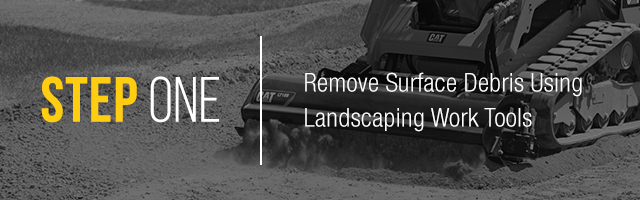
Step 1: Remove Surface Debris Using Landscaping Work Tools

Landscaping work tools are invaluable during site preparation, and even during maintenance, for removing vegetation such as old turf, persistent weeds and junk trees, as well as stumps and big rocks. Some sites look like a jungle at the start of the project, while others may not be as problematic.

Several tools and attachments that make site preparation and maintenance easier include:

Skid Steer Loader

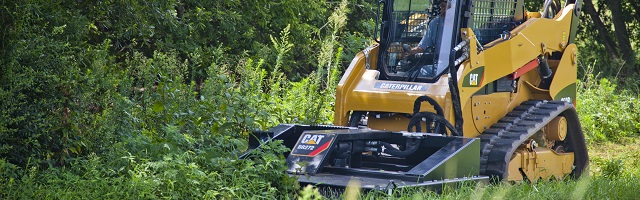
Skid steer loaders are compatible with a variety of attachments, but for removing vegetation, their go-to attachment is a brush cutter. Built for performance, reliability and safety, skid steer loaders provide the power you need to run your brush cutter at optimal performance to achieve faster cutting and quicker project turnaround times. Their versatility also allows you to use them for other project tasks.

Brush Cutters

Brush cutters are the ideal attachment for removing vegetation and brush when preparing a site for a new project, such as clear-cutting a recreational area, or maintaining a site, such as a highway median. With several available cutting widths, they make it easy to clear large sites fast. Attach a brush cutter to a skid steer loader for the best, most efficient results.

Small or Mini Excavators

Small and mini excavators offer the power and performance to make your project productive and efficient when removing large stumps and rocks. Smaller-sized excavators are convenient when working in narrower areas, such as residential locations. Excavators can also dig deep enough to ensure root removal, which prevents regrowth, as well as dissatisfied clients.

Small Dozers

Small dozers are built for smaller jobs such as residential work. They are a viable alternative to using excavators for stump removal, as dozers have the horsepower to remove large stumps with ease. Small dozers have multiple other uses, such as clearing and grading lots.

Preparing and maintaining lots can be a time-consuming drain on your resources. Landscape equipment, however, provides a solution for faster and more cost-effective brush and debris removal using hardware that is durable and reliable.

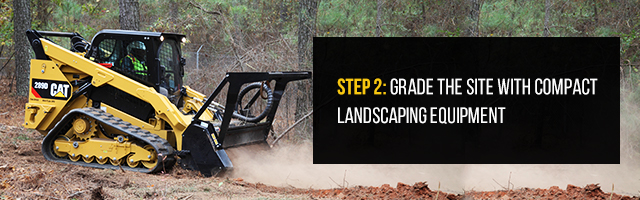
Step 2: Grade the Site With Compact Landscaping Equipment

Grade your debris-free site using compact landscaping equipment for fast and effective results. You will want to assess the location ahead of time for any drainage issues, hills, valleys or other imperfections, such as steep slopes.

It may be necessary to add or excavate dirt to achieve both the desired look and proper drainage. A few types of compact landscaping equipment make these processes more efficient:

Backhoes

A backhoe’s main purposes are trenching, backfilling and moving materials. Improve your productivity with an advanced hydraulic system that delivers precise operating and handling features. Backhoes can also travel up to 25 mph, allowing you to move and shift soil across large construction areas quickly.

Trenchers

Attach trenchers to backhoes for better trench cutting. Trenchers cut straight and narrow trenches for electrical, telephone and cable lines, as well as piping for water and gas service. Manually digging trenches is time-consuming and decreases your team’s output. Trenchers are a smart choice, and they feature several cutting widths to accommodate any job.

Small Dozers

A small dozer’s primary purpose is grade work. Dozers can slope the sides of roads, as well as assist in the final grade work for driveways and landscapes. Unlike over equipment, small dozers are designed to offer unparalleled accuracy for finish grading. Our rental dozers can be equipped with AccuGrade™ Grade Control System to help you grade your site right the first time, saving your team hassle later.

Your site’s finished grade should be even with patios, walkways and other landscape features, and you should leave room for additions like fine-quality topsoil, lime and fertilizer.

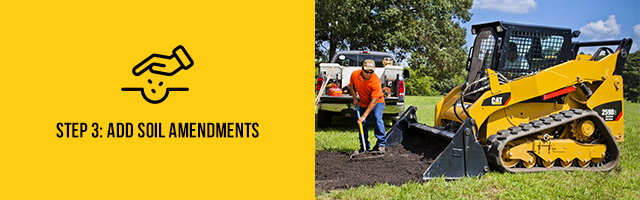
Step 3: Add Soil Amendments

If your landscape contract is residential or commercial, your client may ask you to treat the soil for grass seeding, or the planting of shrubs and trees. Soil amendments — which can include lime, sulfur, weed prevention and other organic materials — are developed and used when tilling the ground.

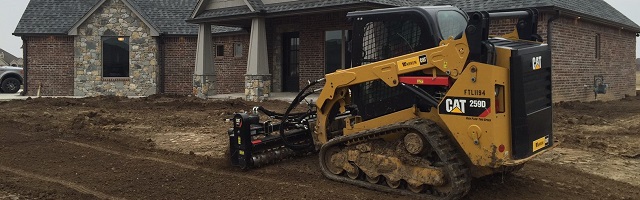
Compact track loaders and tillers are commonly used machines and attachments for filling.

Compact Track Loaders

Compact track loaders offer versatility, traction and stability for tilling soil. Their suspended undercarriage is also a bonus because it minimizes ground disturbance and provides extremely low ground pressure. Certain compact track loaders feature an electronic torque system to manage the loader’s torque and maximize its performance and production.

Tillers

Tillers break up and pulverize soil, which allows soil treatments to mix-in and do their job. Spiral tillers improve cutting performance by 10 percent in comparison to tillers with standard placements. Tines with tungsten offer exceptional strength, durability and longevity. Make your soil amendment process efficient with equipment that’s built to last and drive results.

Soil amending can be a quick and easy process with the right tool, such as a compact track loader with a tiller attachment. Tilling with smaller equipment is an inefficient method, and will only extend your project’s completion date.

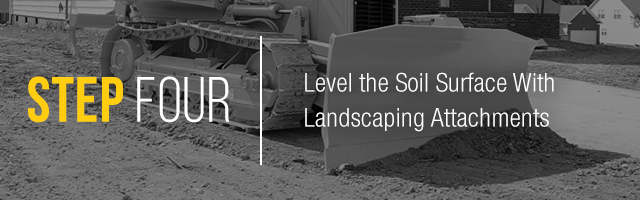
Step 4: Level the Soil Surface With Landscaping Attachments

Attachments for your landscaping equipment are invaluable when leveling the soil’s surface after soil amendments. Make your team’s job easier and more productive with the following attachments:

Rakes

Landscape rakes feature hardened teeth and use a scarifying action to collect rock and debris, which are then deposited into a hopper bucket. Rakes are attached to compact track loaders and will aerate, level and condition soil. They also are available in several widths, allowing you to cover large areas quickly.

Blades

There are several types of blades designed and built specifically for landscaping. Landscaping blades assist in leveling soil after raking, but also for grading soil.

Compactors or Rollers

Rollers and compactors pack-down soil to prepare it for planting and seeding. Rollers ensure that the soil will compact at the right amount, which allows grass seed to fall into the soil and germinate.

Use landscaping attachment equipment to reduce your work time, as well as increase the accuracy and quality of your work. You’ll leave clients with a positive impression, and their recommendations will benefit your company in the long-run.

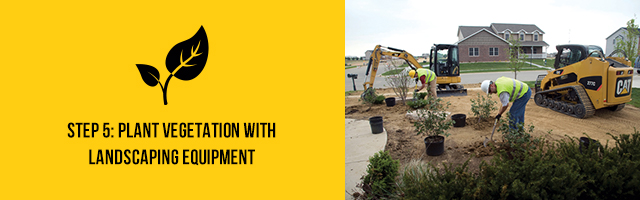
Step 5: Plant Vegetation With Landscaping Equipment

Plant vegetation such as shrubs and trees with durable landscaping equipment to finish the last step of your landscaping project. We recommend a few tools for planting vegetation, especially for larger greenery, such as trees.

Forks

Handle pallets of fertilizer and sod using a fork attachment. Fork attachments are used with loaders and backhoes. Unload sod and fertilizer faster with a fork attachment. Delivering the pallets throughout your work area will save you time compared to manually unloading the materials.

Augers

Use an auger to quickly drill holes for fencing, trees, shrubs and other hardware. Augers are designed for maximum productivity through an optimum balance between speed and torque. Auger bits range in size so they can reach any landscaping project’s depth.

Landscaping equipment like forks and augers can simplify your tasks and increase your team’s production. A quicker project pace allows you to take on more projects throughout the year and potentially raise your company’s profitability.

Rent Landscape Equipment With Ease

While landscape equipment and accessories make projects easier, many contractors raise concern over the cost-prohibitive nature of owning an extensive lineup of equipment and accessories.

Rentals are becoming the go-to option for many professionals in the landscape industry. Renting instead of buying equipment or and attachments is affordable and offers all the benefits of owning the items.

Equipment and attachment rentals offer several benefits, including:

  • Use of the newest hardware. Rentals let you use the latest hardware and technology in the construction industry, without the significant financial investment of an equipment purchase.
  • Access to maintenance and support teams. Certified and highly trained technicians repair and maintain Cat equipment throughout Texas and Oklahoma. Product support is also available 24/7, as well as emergency technical support. Save your time and money by avoiding the need to pay for maintenance, repairs or halted projects due to machine failure.
  • Rental of short-term use equipment. Landscape projects can require equipment you may not have in your inventory. Renting equipment, however, can let you take those jobs without buying equipment or attachments that your company does not need for daily operations.
  • Reduced costs compared to equipment purchases. Equipment and attachment rentals are often more cost-effective, especially if the hardware is only for one project, in comparison to purchasing or financing equipment over a set number of years.
  • Availability of daily, weekly and monthly rentals. Equipment and attachment rentals are available in varying durations to fit your project’s estimated timeframe. At Warren CAT, we offer daily, weekly and monthly rentals, as well as longer-term rental durations.
  • Rent-to-own and lease options. Rent-to-own agreements allow you the opportunity to rent equipment, typically for six months, and then choose to purchase the equipment after that timeframe. You can often use your completed rental payments as a down payment. Leasing options assist in longer-term projects, extending over a year, and can include a purchase or renewal option at the end of the agreement.

Landscape equipment rentals are a convenient and cost-effective alternative to purchasing new equipment. At Warren CAT, certified technicians service and test our rental equipment regularly. We also offer easy ordering and delivery, as well as expert advice on choosing equipment that fits your individual project or contract’s needs.

Manipulate Landscaping Equipment for Advantages

Cat landscaping equipment and attachments expedite the creation of perfect lawns and landscapes. These multi-capable machines save hours upon hours of manual labor.

It helps to know about the different types of equipment and their capabilities. Check out our list of go-to landscape equipment:

  • Backhoes provide the dual and versatile ability to do tasks from both ends, and the extent of what they can do may depend on the attachments chosen. Backhoes are typically used for digging — for example, trenches for irrigation or drainage — but they can also carry loads, level soil and perform various other tasks. New Cat backhoes offer digging depths ranging from 14 to 17 feet, allowing for a broad range of trenching capabilities.
  • Mini excavators allow for close radius maneuvering and digging, which permits a wide range of landscaping activities in tight spaces. Excavators are well suited to dig trenches for drainage or irrigation systems, especially in places a backhoe would not be able to reach. You can also outfit your mini excavator with a variety of attachments including augers, thumbs, compactors and buckets.
  • Skid steer loaders usually roll on rubber tires, so they are a preferred choice when the work involves travel on concrete, asphalt, curbs, sidewalks or other paved surfaces. Skid loaders can be equipped with multiple attachments to dig, carry, smooth and grade soil.
  • Compact track are fitted with a rubber undercarriages that minimize ground disturbance with extremely low ground pressure, making them a great option for jobs with preexisting lawns. Like skid steer loaders, they can be equipped with a multitude of landscaping attachments to ensure maximum versatility and productivity.
  • Telehandlers (also called variable-reach forklifts) are multipurpose machines with attachments, such as carriages and buckets, to help load, carry and place materials. The telehandler’s reach enables contractors to lift wall bricks into place or lay sod without having to walk on or touch the material after placement. Cat telehandlers offer lift heights ranging from 42 to about 55 feet.
  • Compact wheel loaders feature improved fuel economy and reduced emissions, while still maintaining their high performance, versatility and precision. Attachments for compact wheel loaders can be changed out in as little as 30 seconds to keep projects moving. Compact wheel loaders are great options when you need larger bucket capacities than available with a skid loader.
  • Small dozers optimize finish grading accuracy and are ideal for residential construction jobs. In addition to final grade work, small dozers can also clear and grade lots, slope roadsides, and back-fill.

Explore Landscaping Attachments and Accessories to Do Endless Jobs

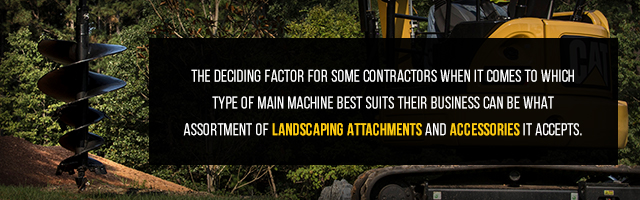
The deciding factor for some contractors when it comes to which type of main machine best suits their business can be what assortment of landscaping attachments and accessories it accepts.

Accessories can make a huge difference in a variety of landscaping tasks:

  • Augers dig precise holes for trees and shrubs, as well as fence-post holes, deck footings and many types of playground foundations and supports. They come in different sizes and can be programmed to dig to a specific depth so that all the holes are uniform. Augers can be attached to loaders and excavators.
  • Blades move materials around the job site efficiently and can level dirt and stone. They are ideal for snow removal. Different types of blades, such as the angle, box, dozer, wood chip and others, cater to different landscaping purposes. With many available widths, they have the potential to make landscaping and lawn work infinitely easier.
  • Brooms fit on most loader models, provide great after-project cleanup and serve as efficient, effective maintenance tools. One quick pass of the wide broom sweeps walking paths clean, as well as parking lots and other areas. In climates where it snows, brooms sweep away the snow that would be otherwise difficult to remove with just a plow or shovel. These brooms can be regular utility brooms, or specifically angled and designed for pickup.
  • Brush cutters clear overgrowth and thick vegetation from highway medians and utility easements. They are also a go-to tool for initial land clearings for housing, parks and recreational areas. Brush cutters are durable, fast and offer cutting widths ranging from 60 to 78 inches. Brush cutters are ideal attachments for compact wheel loaders, compact track loaders, multi-terrain loaders and skid steer loaders.
  • Bucket attachments will also expedite work and help workers avoid back strain. Many bucket variations fit onto excavators, loaders and backhoes. Some buckets dig, grade and lift or handle mulch, while others sort rocks for drainage utilities and erosion control.
  • Forks are suited to lift pallets up, down and around, but they can also serve other purposes. Contractors often use them to handle sod, fertilizer and decorative landscaping elements. Specialty forks, such as the ones used for blocks, construction or industrial grappling, are also available. Forks can be fitted for use on loaders, backhoes and telehandlers.
  • Mulchers process thick undergrowth and small brush like an industrial mower would. Mulchers are great for land reclamation, foliage removal and shredding pruned materials. They can be attached to a skid steer, multi-terrain or mini loader.
  • Rakes reap the rewards of refining soil for planting or grooming. Rakes attach to a loader to cover wide swaths at a time and remove or bring up unwanted debris, such as rocks, dirt clumps and errant vegetation, before planting. While there are industrial sizes and box-type rakes, landscape rakes range from 72 to 84 inches wide.
  • Compactors or rollers provide the right amount of tamping for the soil to assume the proper structure. These barrel-like devices roll across the surface of the new lawn to solidify it. Most lawn experts know there’s a fine line between soil that prevents germination and soil that encourages it.
  • Stump grinders smooth out a landscape by shaving off stumps to several inches underground. The effect is an uninterrupted planting surface. Cat stump grinders provide an advantage over tow-behind grinders because they balance their torque to work the stumps down quickly and evenly.
  • Tillers lend a winning hand in the quest for a perfect lawn because tillage prepares the soil to accept and nourish whatever is going in it. The machines mix in fertilizer, break up existing earth, blend in soil amendments such as lime and optimize the planting surface.
  • Trenchers help dig the ditches required for sprinklers and drainage, plus they can cut through any roots that start to grow in the wrong direction. Trenchers are also ideal for running underground wires for landscaping lighting and other electrical needs.

Depend Upon Professional Partners

Warren CAT makes it possible to create the perfect lawn or landscape with cost-effective, reliable and durable equipment that increases your project’s productivity and your team’s efficiency.

We maintain a generous inventory of new and used machines for sale and rent. We offer full service, parts, maintenance plans and suggestions for how to acquire a combination of machines, attachments and accessories to benefit and grow your business.

contact warren cat

Whether you’re looking for rental landscaping equipment or new Cat landscaping equipment or used machines to buy, we’re committed to helping you find the best equipment for your project. Our professionals in each one of more than a dozen locations throughout Oklahoma and West Texas can provide information and resources. Contact us today to learn more.

A Guide to Equipment Field Service

If you own heavy equipment, you may be considering field service. Many businesses have questions about field service, and whether it’s right for their business.

This guide will introduce you to the differences between on-site equipment repair and repairs made in the shop. We’ll also guide you through the most common field service repairs, and provide tips on how to make field services effective for your business.

What’s the Difference Between Field Service and Repairs Made in the Shop?

When equipment breaks down or requires maintenance, you have two primary options. You can have your equipment repaired on site, or you can take it to a shop for repairs.

On-site equipment repair is usually referred to as field service, but it isn’t only for emergencies. It can also include routine on-site equipment maintenance and services.

Another alternative is to take your equipment to the shop for repairs. Regular maintenance and repairs can be performed in the shop. However, some major services, like rebuilds, are performed exclusively in the shop.

Key Differences Between Field Service and Shop Repairs

Field service is available on the job site, and it offers 24/7 service. Most services are similar or identical to those that can be performed in the shop.

24-7 service

With shop repairs, equipment must be transported to the garage, and most repairs are made during normal business hours. Major services like the Cat® certified rebuild are performed in shops.

Why Do Businesses Use Field Service?

reduce downtime

Some customers wonder why they should consider field service. Although field service isn’t the right choice for all businesses, it can be essential for some. Field service can reduce downtime, cut transportation expenses and keep a job site on schedule.

There are three primary reasons that businesses use field service:

  1. The equipment is too large to transport easily. You should consider a field service contract if your equipment is too large to transport to a shop, or if transportation will be expensive or difficult. If your equipment includes large equipment like cranes, drillers, or large excavators, consider on-site repairs instead of transporting them. Certified Cat technicians can maintain and repair this equipment in the field instead.
  2. You need to get equipment working quickly. Another reason to consider field service is the busy schedule at job sites. When you can’t afford to have a machine out of service for several days — or even several hours — on-site repair can be the answer. Since field service technicians are available around the clock, they’ll get your equipment back to work quickly. Many businesses also schedule on-site maintenance during equipment downtime so that they can stay on schedule.
  3. 3) The equipment is immobilized. Finally, many businesses use field service to repair equipment that has broken down in a way that immobilizes them. This can include damage to the hydraulics or transmission system. It can also include engine damage. Finally, issues that affect the track or wheels on equipment can immobilize it. In these situations, you can actually do more damage if you attempt to transport this equipment to a shop. On-site repair can either resolve the issue, or get the equipment working long enough to get it to a shop to finish repairs.

equipment field service

What Types of Field Service Are There, and Which One Is Right for Me?

There are two main types of Cat field service: emergency services and scheduled maintenance. When you’re considering field service, you may have questions about how each type of field service works, and about which type is right for you.

1. Emergency Field Service

Many people think of emergency service when they consider field services. When you use emergency field services, a Cat certified equipment technician will come to your job site to repair broken or damaged equipment. Emergency field service is often used when equipment is immobilized.

Common reasons for emergency field service include:

  • Damaged engines or transmissions
  • Issues that affect the tracks or wheels on equipment
  • Damaged equipment that’s too large to transport to a shop

One of the biggest benefits of emergency field services is that you don’t need to transport the equipment. If an engine, transmission or track system is too damaged to allow equipment to move under its own power, it’s a good time to use emergency field service.

Emergency field service is also used when you need to get equipment back to work immediately. If you have specialized equipment, or finding a replacement will be difficult, consider using emergency field services. Technicians will come to your job site 24/7 to repair this equipment.

2. Scheduled Maintenance Field Service

The second type of field service offered is scheduled maintenance. Technicians will come to your job site on a pre-determined schedule to maintain equipment. Common types of scheduled maintenance include engine, transmission and undercarriage maintenance.

Scheduled field service is often used when equipment is too large to transport easily. Instead of paying to transport your equipment to a shop for routine maintenance, a technician will come to you.

Many people also schedule maintenance at the job site, because you won’t lose equipment for the day. You can even schedule routine maintenance at night. With on-site scheduled maintenance, you can keep your equipment in good shape and get back to work immediately after the service.

Can I Use Field Service With All Types of Equipment?

Most businesses use field service for heavy equipment that’s not practical to transport for repairs. This can include:

heavy equipment service

However, field service isn’t only for heavy equipment. Some businesses use field service for both on- and off-road trucks as well. Field service for trucks works similarly to field service for heavy equipment: Let us know where you are, and we’ll come to you to repair your truck. You’ll cut out the time and expense of transporting your truck for repairs, and get you back on the job faster.

Field Service for Power Systems

Field service can also be used to maintain and repair generators and electrical power systems. Power service is usually used by businesses that use generators or industrial engines in the field. However, hospitals, manufacturers and factories can also utilize field service for UPS systems and backup generators that cannot be transported to a shop for repair.

What Types of Repairs Can Be Done in the Field?

Many people are surprised by the range of repairs that can be done in the field. Technicians can repair damage to the electrical system and attachments like buckets or blades as part of a field service call. We can also repair damage to the engine, transmission system and hydraulics in the field.

Our mobile service trucks are fully equipped with diagnostic equipment and repair tools. We can access data from your equipment in the field to determine how well it’s performing, and make repairs right there. Service trucks have the equipment needed for on-site welding and boring, repairing electrical systems and replacing hydraulic lines.

Not all repairs are mechanical. Cat technicians can install the latest software and security updates during field service as well. They’ll bring upgrades and product manuals to the job site with them, and upgrade your equipment as part of their routine maintenance.

What Are the Most Common Types of Field Service Repairs?

The field services we offer are as varied as the equipment in your fleet. Many of our field service visits are made to repair or optimize sophisticated hydraulics, powertrains or electronic systems. Read on to learn about some of our most popular field services.

field sevice repairs

1. Hydraulics Repairs and Servicing

Over the years, hydraulic systems have gained complexity. These sophisticated systems offer increased equipment performance. They’ve also made regular service and maintenance more important than ever.

Many of our field service calls for hydraulic systems are focused on emergency repairs. Warren CAT technicians use sophisticated diagnostic equipment to diagnose problems and optimize your system.

We can also provide preventative maintenance for hydraulic systems as part of our field services. Technicians can do inspections, optimize systems and check for contamination on your job site.

warren cat field service

If you need more in-depth hydraulic services, Warren CAT has four hydraulic centers located throughout Texas and Oklahoma. These centers include specialty equipment for testing and complex repairs. Hydraulic technicians are trained to service and repair Sauer, Sundstrand, Danforth, and Bosch Rexroth systems, among others.

2. Engine Service

Engine issues are one of the top reasons that businesses need emergency field services. A damaged engine can immobilize your equipment, making it difficult to transport to a shop for repairs.

Warren CAT can do major and minor engine repairs in the field. We work with a wide variety of engine types, including:

  • Diesel engines
  • Standard fuel engines
  • Generators
  • Uninterruptable Power Supply Systems

Field services include major component repair and replacement for all major brands. We can make repairs with new parts or with used or rebuilt parts. As an authorized Caterpillar® dealer, we have exceptional access to replacement components for Caterpillar engines.

Many businesses choose to include engine or generator services as part of their scheduled maintenance. This scheduled maintenance usually includes visual inspections, testing and fluid sampling.

3. Undercarriage Repairs and Maintenance

The undercarriage of most heavy equipment can take a beating on the job. Field service technicians can provide both undercarriage repairs and maintenance.

We’ll often do undercarriage inspections and maintenance as part of our regular field services. During these inspections, a technician will visually inspect and measure the thickness of your equipment’s undercarriage. We’ll look for loose nuts and bolts, uneven wear and other alignment issues. This will help us predict if and when major repairs need to be made.

Technicians can also repair undercarriages in the field. We can weld and repair cracks in the undercarriage, fix alignment issues and repair tracks to get your equipment moving again.

4. Oil Sampling

oil sampling

Oil sampling is often a part of maintenance field services. This is a scheduled service, in which the technician draws samples from your equipment’s oil, coolant and fuel. The samples are usually analyzed in a lab. Your technician can use them to identify issues and to optimize your equipment’s performance.

Once samples have been analyzed, your technician will send you a report on the results. They’ll usually include recommendations for optimization based on the results.

Oil sampling can cut down on your repair expenses by identifying minor issues before they turn into major repairs. It also serves as a valuable part of your service documentation, which can increase your equipment’s value if you trade it in or sell it.

5. Welding and Fabrication

Our repair facilities include state-of-the-art welding and fabrication equipment. Here, we’ll undertake major jobs like creating customized attachments or repairing your equipment. Over the years, we’ve welded or fabricated almost every component of most heavy equipment.

We often do welding and fabrication as part of a field service call as well. Most welding or fabricating done in the field is used to repair or replace a broken part, so that you can get back to work. Specialty attachments are usually fabricated in the shop.

If you need parts welded or remade on site, a field service call can make it happen. All of our field service trucks carry portable welding and machining tools. You’ll save time and money by fixing parts instead of ordering new components.

In addition, our skilled field service technicians are factory trained in welding and machining in the shop and in the field. That experience and skill will make a difference for your equipment: a high-quality welding repair is stronger and more durable. By contrast, a bad welding job can cost you more in downtime and repairs.

What Should I Consider Before Using Field Service?

If you’re planning to utilize field service, consider your current maintenance needs. Look at the previous year’s maintenance and upcoming equipment services to figure out what types of service you need.

Knowing more about the state of your fleet and current maintenance needs will help technicians optimize your equipment. Answer these questions to figure out more about what your fleet needs:

  1. Do you currently have a service agreement? If so, how often have you used it?
  2. What types of services have you had done in the field in the last year?
  3. What regular maintenance has been done this year?
  4. Do you have a regular maintenance schedule? Would you like to adjust it, or stick to the same schedule?
  5. How old is your equipment?
  6. What types of equipment do you own? (Consider both manufacturer and type of equipment.)
  7. What are your typical job sites like?
  8. Is there a regular time of day that would be ideal for routine service? If not, how far in advance would you like to set up regular service calls?
  9. Does any of your equipment have recurring repair issues?
  10. Do you have optimization or performance concerns that a tech should be aware of?

Do I Need New Equipment Management Software for Field Services?

Some fleets use specialized equipment management software to track their fleet’s performance. If you already have software in place, you can keep using it.

Warren CAT also offers you access to VisionLink, the next generation of equipment management for Cat machines. This is a web-based application that consolidates data about your vehicle’s performance and repairs.

If you use Cat equipment, VisionLink is probably already installed on your equipment. When you activate VisionLink, your software will use GPS and cellular technology to send updates on your vehicle’s performance to the equipment management software. This will help you and your technicians identify problems early.

What Happens If I Don’t Use All of My Services?

You don’t need to worry about meeting a pre-set product or service requirement as part of a customer service agreement. We’ll work together to figure out what types of service and maintenance you need.

If you know what types of service you need and already have a maintenance schedule in place, consider a regular service agreement. We’ll help you set up a monthly service contract. You can keep the same maintenance schedule, with the added convenience of our technicians coming to your job site.

Customers often choose a monthly flat fee to pay for these customer service agreements. You’ll always know ahead of time how much you’re paying for service. And that can help keep your business on budget.

Some customers prefer to set up a service agreement in which cost is based on production hours. If you have new equipment and don’t yet know what service requirements look like, this type of agreement can be a good choice. You might also choose this type of agreement if you don’t currently have a maintenance schedule in place.

Finally, customers whose job load and machine hours vary dramatically over the year sometimes choose this type of agreement. Customers with seasonal businesses like agriculture often find this flexibility useful.

field service

How Do I Get Started With Field Service?

Most field service is offered as part of a Customer Service Agreement (CSA). To set up a service agreement in Oklahoma or Texas, contact our service division.

However, to utilize field service, a service contract is not needed. Our field services are available 24/7 by request and are a great option for emergency service needs.

equipment service

We can help you set up a service agreement for regular maintenance, emergency repairs or both. We’ll work with you to customize a service agreement that meets your needs.

Field service agreements range from simple preventative CSAs to our Total Cost Performance Guarantee. The type of agreement you choose is based on your equipment, your business needs and your budget. We’ll work with you to customize the frequency of service, the types of services performed in the field and your payment plan.

To schedule field service or to learn more about our service offerings call or contact us today.

Guide to Choosing a Power Generation System

Choosing a power generation system is a big decision. Whether your power generating needs are temporary and supplemental to the established grid or intended to be a primary source of electricity, you need to choose a generator carefully and wisely. That comes from assessing your options of what’s available on the market. It’s also what best fits your particular application.

types of generators

Choosing a generator from among the huge variety of options doesn’t have to be a difficult or stressful task. There’s a tremendous amount of information available. Unfortunately, much of it’s self-interested and doesn’t give you an objective and accurate look. That’s where an impartial guide to choosing a power generating system is invaluable.

Factors in Choosing a Power Generation System

Matching the right generator to your existing demands is crucial to successful operation. Output wattage size is vital. The particular brand name and model is important. So is the location where you’re operating your generator as well as climate factors and availability of service. Then you need to consider small details such as safety devices, displays, ease of maintenance, interface switches and, of course, the price.

choose a generator

All of these features and benefits form part of what you base your generator purchase decision on. They’re important to form the big picture. But almost always, one of the main criteria for choosing a power generation unit is the type of fuel required to power the generating engine. This decision is easy enough to overlook, but its significance is considerable.

Choosing a generator based on a predisposition or prejudice to one type of fuel alone can be misleading. There have been so many advancements in generator technology in recent years. What was true ten years ago might not be reliable fact today, especially in fuel. Perceptions that natural gas vs. a diesel generator is an inferior choice or that gasoline vs. a diesel engine has better economy can be wrong.

Overview of Power Systems

To guide you in making an informed choice when choosing a generator system, let’s first look at the heart of the generator. That’s the engine.

generator engine

A power generation system is composed of two main parts. There’s the generating unit itself that makes and conducts electricity. That’s done on the principle of electromagnetism established for decades. There have been huge advances in improving armatures and coils integral to an electric generating field.

The second team member in a generating system is the engine that turns the rotor. With few exceptions, generator engines use the internal combustion system where fossil fuels are ignited inside sealed cylinders.

Renewable vs. Non-Renewable Resources and Power Systems

Fossil fuels are non-renewable resources. Unlike renewable resources such as wind, solar and water power that drive advanced and large electrical generation systems, fossil fuels are the number one choice for smaller residential, commercial and industrial generating systems. This includes permanent, stationary back-up generators as well as portable generating units.

All fossil fuels originated as the result of decaying organic compounds buried under the earth’s surface. Some fossil fuel deposits date back millions of years to when dinosaurs roamed the earth and huge ocean floors as well as surface jungles contained plants and animals. As they died and accumulated, the heat and pressure from natural action compressed these remnants. This changed their carbon structure, making them ideal energy sources for today’s internal combustion engines, including generators.

generator fuel types

The three main fossil fuel sources for generator systems are gasoline, diesel fuel and natural gas. Each fuel type has pros and cons, which we’ll examine in a bit. First, it’s helpful to know what each fuel is so you can understand and weigh the advantages and disadvantages.

Gasoline Power Systems

Gasoline is also known as petroleum distillate or “petrol” in some countries. Gas is the most common fossil fuel for small engines, including passenger vehicles, light trucks and smaller electrical generator sets.

Gasoline is refined from crude oil and other petroleum products. According to the Energy Information Agency (EIA), refineries in the United States produce about 19 gallons of gasoline from every 42-gallon barrel of crude oil. Finished gasoline you buy at the pump comes in three octane, or quality, grades. These grades are rated as regular, midgrade and premium. The grades dictate the burn rate and anti-knock values of each type.

Gasoline used to contain lead to prevent pre-ignition, which is what caused the knocking sound from gas engines. Lead in gas was banned in 1975. Now other chemical properties are added to gasoline to make it perform better. Gasoline remains highly flammable and subject to fire.

Because gasoline is unstable as a liquid and vapor, it requires special storage and delivery systems for safety. It also has a different ignition method where it requires a spark. Gasoline engines utilize spark plugs and distributor systems for igniting this fuel inside an internal combustion engine. This presents some advantages of gas vs. diesel engines. Gasoline powered units present some disadvantages and safety concerns.

Diesel Fuel Power Systems

Rudolf Diesel was a German engineer who realized gasoline was undesirable due to its flammability at ambient or air temperature. Gasoline also burned hotter and caused more strain on moving engine parts. Diesel discovered another way to produce a crude oil-based fossil fuel that would not ignite by a spark. Rather it would combust at lower temperatures when mixed with air and highly compressed inside a specially designed internal combustion engine.

People have used diesel fuel for decades. It requires a different processing method that, according to the EIA, allows for 12 to 13 gallons of diesel fuel to be produced per barrel of crude oil. Diesel fuel is inherently stable when in an open environment and is much safer than gasoline under most conditions. It can’t be ignited by a spark like gas can. But it can be slowly burned with an open flame, which is why diesel fuel is sometimes used for heating oil.

diesel generators

When diesel fuel is compressed, it has different reactions. Inside an engine’s cylinders, diesel flashes into ignition at a much lower temperature and burns with much more energy efficiency than gasoline. This is called the flash point. With diesel, it’s 265 degrees Celsius, whereas with gasoline the internal flash point is 280 degrees Celsius. That’s why diesel engines run cooler than gasoline engines. It’s also why they’re known to run much longer.

The lower operating temperature of diesel engines has a clear advantage (compared to gasoline engines) besides exposing the moving parts to less heat, therefore less wear and tear:

  • Diesel fuel combusts far more of its volume than gasoline. This makes the fuel efficiency function or energy density higher, which is why diesel engines are considered more fuel efficient.
  • Also, because the ignition and full burn occur at lower temperatures and engine speeds, diesel engines are considered to have more lower-end power or torque.

diesel fuel

Diesel engines have a nasty reputation for being noisy and dirty. This bad rap is somewhat undeserved in the face of new diesel engine technology. It’s one reason why the third type of fossil fuel is becoming increasingly popular. That’s natural gas.

Natural Gas Power Systems

Unlike gasoline and diesel fuel, which are liquids refined from crude oil, natural gas is exactly that. It’s a gas. Natural gas occurs deep in the earth. It’s also a fossil fuel that arrived in its present form through decay of organic compounds from plants and animals.

Natural gas is mainly composed of methane that chemically forms in a gaseous state unless it’s deeply compressed or chilled. In its natural form, methane mixes with sand and silt, forming huge deposits of fossil fuel that can be artificially fractured. This releases natural gas where it can be captured in wells, then pressurized into pipelines or cooled to be shipped in containers.

In raw form, natural gas is tasteless, colorless and odorless. It’s also highly explosive when exposed to air and can be set off by the slightest spark with the right air and fuel mixture. This is why an additive called mercaptan is processed into natural gas and gives its familiar warning smell described as rotten eggs.

Once natural gas burns, it has little waste or by-products other than water. That makes natural gas a clean-burning, popular choice in urban environments where air pollution is a problem. Natural gas also quickly dissipates once escaping from containment. That alleviates the mess from diesel and gasoline spills, which can be disastrous to clean up.

For these reasons, natural gas is the most economical and plentiful form of fossil fuel. It’s relatively easy to harvest and contain, and delivers excellent value as an energy source. According to the Energy Information Agency, Americans used 27.5 billion cubic feet of natural gas in 2015.

natural gas fuel

Natural gas is a main fuel supplier to the U.S electrical power grid. It’s also widely consumed for industrial, commercial, transportation and residential use as a heat source as well as powering internal combustion engines. That includes the engines on many stationary and portable electric generation systems.

There are a few other fuel options for powering electrical generators like propane or natural force energy sources such as wind and solar. But for your generator selection, you’re most likely to choose a conventional fossil fuel. It comes down to gasoline, diesel or natural gas.

Advantages and Disadvantages of Different Fuel Sources

Let’s now weigh the advantages and disadvantages of gasoline, diesel and natural gas engines when used on power generation systems. You’ll see some of the pros and cons overlap and outweigh each other, but this should help guide your choice.

1. Advantages of Gas Generators

Gasoline was the first fuel used in the invention and evolution of the internal combustion engine. It works on a system where raw, liquid gasoline vaporizes into a controlled air mixture through carburization or fuel injection. Once it’s enclosed in a combustion chamber, gasoline needs igniting by a spark. This requires spark plugs that are set off through an electro/mechanical distributor system.

Some of gasoline’s advantages are:

  • Proven system that’s widely known and understood
  • Ready and widely available fuel supply
  • Works well with other gasoline-supplied machinery for fuel control
  • Relatively good fuel economy
  • Operates well in extreme climates, both hot and cold
  • Relatively clean burning and low maintenance from fuel contamination
  • Lower initial purchase price
  • Inspires engines with more compact, lighter and versatile design

Some of gasoline’s disadvantages are:

  • Highly flammable when exposed to air and a spark
  • Unpredictability of fuel prices
  • Hotter burning, causing more wear and tear on moving parts
  • Lower energy density so less fuel economy
  • Lower torque and power production at low speeds
  • Less life span for engine components
  • Higher depreciation rate and lower resale value
  • Limits in the size of the unit and power output

2. Advantages of Diesel Generators

Diesel fuel was developed as a more stable and lower cost alternative to gasoline. Diesel engines do not have spark plugs or distributors to ignite the fuel, giving them less systematic parts and less that could go wrong. Liquid diesel fuel is injected directly into the combustion chamber, where the action of the valves and pistons mix the proper air-to-fuel ratio to a combustible volume. Diesel engines are the most popular and widely used power plant propulsion, for a number of good reasons.

Some of diesel’s advantages include:

  • Very stable fuel from safety standpoint
  • Excellent energy density and return for fuel economy
  • Produces most power and torque at lower speeds
  • Less wear and tear on moving parts
  • Longer engine life
  • More dependable performance
  • Higher power outputs
  • Heavier, better manufacturing materials and processes
  • Lower depreciation and better resale value
  • Plentiful supply of fuel
  • Safe and easy fuel storage

Some of diesel’s disadvantages are:

  • Burns with notable by-products, including carbon in exhaust
  • Noise factor, particularly in older model engines
  • Higher initial purchase price
  • Less reliable in extreme temperatures
  • Harder to start in cold, more difficult to shut off in heat
  • Fuel tends to contaminate easily
  • More expensive initial purchase price
  • Engines are usually bulkier and require more room to operate and store
  • Diesel prices fluctuate considerably, especially with the seasons

3. Advantages of Natural Gas Generators

Although diesel fuel and gasoline engines have been the traditional choice for power generation systems, natural gas as fuel alternative is becoming increasingly popular. That’s due to technological advancements and an evolving supply grid for natural gas distribution.

Natural gas internal combustion engines work on the same ignition principle as gasoline models. Natural gas as a vapor is injected right into the combustion chamber and ignited by a spark plug and distributor wiring system. Natural gas burns in the cylinder, and the exhaust is piped out into the atmosphere. There are few harmful emissions, and it’s considered the cleanest-burning fossil fuel available.

Distribution and storage of natural gas has its limitations. Most applications for natural gas generators are in close proximity to urban areas, where the pressurized gas pipelines are established. Otherwise, natural gas has to be trucked in with specialized containers and stored at the generator location in high-strength containers.

Many natural gas generators are used right at natural gas production facilities where their fuel is tapped into the masthead. This is an economical, practical approach, but is limited to gas field application. In other areas, natural gas is not as popular even though its purchase cost per volume and return on energy density is excellent.

That’s simply due to the distribution and storage issues, not to the overall advantages and disadvantages of a natural gas vs. diesel vs. gasoline generator.

Some of natural gas’s advantages are:

  • Extremely clean burning with limited pollutants
  • Low cost per volume of gas consumption
  • Good return on energy density and overall consumption
  • Works well with conversions from gasoline engines
  • No need for distribution and storage costs when piped into existing grid
  • Low maintenance due to clean operating environment
  • Not prone to spill cleanup
  • Stable, relatively predictable fuel pricing

Some of natural gas’s disadvantages include:

  • Not as popular as diesel and gasoline, therefore fewer models available
  • Emerging technology challenges with unproven techniques
  • Storage and handling costs if not piped-in
  • Initial purchase of natural gas generators is high
  • Considerable depreciation and lower resale value than diesel
  • Less torque and horsepower capability than diesel
  • Highly explosive substance when escaped from containment

Comparing Performance in All Three Types

As you can see, all three types of engines have their advantages and disadvantages. But how do they compare with each other in various performance categories? Let’s look at how gasoline, diesel and natural gas generators stack up in 12 different areas using performance ratings of low, medium and high.

1. Gasoline Generators

Gasoline powered generators perform best in extreme temperature environments. Their initial purchase cost is also attractive, but gasoline engines don’t stand up well in the long term compared to diesel and natural gas, nor are they as safe to operate due to fuel flammability.

  1. Purchase Cost — Low
  2. Depreciation — High
  3. Fuel Cost — Medium
  4. Energy Density — Low
  5. Durability — Low
  6. Reliability — Low
  7. Noise Factor — Medium
  8. Safety Factor — Low
  9. Fuel Availability — Medium
  10. Fuel Storage — Medium
  11. Emissions — Medium
  12. Extreme Temperature Performance — High

2. Diesel Generators

Diesel engine generators are considered the best overall performers, especially in fuel efficiency and dependability. Diesel is the safest fuel source, the widest available and stores well. However, the noise and emission factors place diesel behind gasoline and natural gas.

  1. Purchase Cost — Medium
  2. Depreciation — Low
  3. Fuel Cost — High
  4. Energy Density — High
  5. Durability — High
  6. Reliability — High
  7. Noise Factor — Low
  8. Safety Factor — High
  9. Fuel Availability — High
  10. Fuel Storage — High
  11. Emissions — Low
  12. Extreme Temperature Performance — Low

diesel generator benefits

3. Natural Gas Generators

Natural gas engines are the cleanest burning and have the lowest fuel costs of the three generator types. They’re middle of the road in holding value, reliability and safety. Natural gas in the United States is fairly abundant and relatively cost-efficient.

  1. Purchase Cost — High
  2. Depreciation — Medium
  3. Fuel Cost — Low
  4. Energy Density — Medium
  5. Durability — Medium
  6. Reliability — Medium
  7. Noise Factor — Low
  8. Safety Factor — Medium
  9. Fuel Availability — Medium
  10. Fuel Storage — Low
  11. Emissions — High
  12. Extreme Temperature Performance — Medium

Emerging Generator Technology

Technology is advancing all the time, and new types of generators are introduced to the market on an ongoing basis. Here are a couple of emerging technologies to be aware of and consider for your generator choice.

Gasoline powered the first internal combustion generator engine. It evolved into a diesel model and later into one powered by natural gas. Like all inventions that prove their worth, generators continue to evolve in many ways, too.

Next-generation generators use advanced computer controls for their operation and monitoring systems. More sophisticated materials extend generator service life and reduce maintenance requirements. This leads to less downtime and an increase in productivity. This is all good for consumer investment.

Hybrid and Biofuel Generators

One of the most interesting breakthroughs in generator design and operation is new forms of fuels and hybrid blending of current systems. Hybrid by definition means to bring two items together to serve a common purpose. With generators, that should include more efficient machines that produce electrical power with less expense.

hybrid generators

Experimentation in the hybrid blending of gasoline and natural gas fuels works on the principle of starting the generator with gasoline, which is better at boosting energy. As the generator gets up and running, the fuel supply is replaced with a steady flow of natural gas, which is more efficient and less costly.

After the initial purchase cost of a generator, your next-biggest bill is going to be fuel. The cost of fossil fuel is going to continue to rise despite the identification of new domestic sources and improved methods of distribution.

Biofuels are an excellent example of new technology being put to use in generators. Biodiesel is a blend of conventional diesel fuel and other combustible organic products such as vegetable matter. Bi-fuel is another hybrid energy provider that works with diesel having natural gas injected into the air intake system for added economy.

Browse Dynamic Gas Blending Systems

There are promising things to come in the future of power generation systems and lots of options for you to choose from. Knowing the advantages and disadvantages of the three main fuel sources should be part of your considerations when choosing a generator. There are other factors to consider.

Other Factors to Consider When Choosing a Power Generation System

The foremost consideration you need to assess is exactly what purpose your generator will serve. The second consideration is how much you’re prepared to pay for it. We’ll set your purpose and budget aside because you probably have these two issues identified before looking into these finer factors to consider, such as:

  • Generator size. This is rated in KiloWatts for most and in MegaWatts for huge applications. It’s best to discuss the actual sizing with a professional generator supplier. In most cases, commercial and industrial applications require diesel or natural gas units to satisfy their wattage needs.
  • Reliability. You need to be assured your generator comes from a reputable supplier that has a proven record of performance as well as servicing. Also consider the option of an integrated emergency power system.
  • Warranty. Your brand selection should be made after looking at how comprehensive and reliable the coverage is.
  • Maintenance. Selecting a low-maintenance generator will save you a lot of downtime. Good generator manufacturers like Caterpillar® have excellent service packages as well as providing reliable machines with excellent warranty.
  • Safety. Your generator needs to run safely. That includes emitting low noise, being low in fire-risk and designed so nearby workers are not exposed to heat and moving parts. Talk to your Cat® dealer about the safety features built into every Cat power generation system.

power generation systems

Consider Cat Your Power Generation System Provider

Cat is the world’s most recognized brand when it comes to providing heavy-duty equipment, including the best diesel and natural gas powered generators. The Caterpillar name is synonymous with quality, dependable and versatile equipment.

Warren CAT is an authorized Cat dealer providing power generation systems throughout West Texas and Oklahoma. We’ve dedicated our business to providing customers with complete solutions to all heavy equipment, including generators.

Contact us today or give us a call at 866-292-7736 to talk to us about the power solutions that will serve you best. We’re happy to guide you and help you make the right choice. Trust Warren CAT for clean, continuous power.

Event Power Solutions

Planning a successful event is a challenge. Coordinating suppliers and vendors takes organization, resourcefulness and great communication skills. So does making sure your event has all the amenities needed. Missing a small step can cause a big problem.

Many customers have questions about how to rent power equipment for weddings, sports events, fairs and festivals. We often hear questions about how to select equipment and how to determine what is needed. One of the most common questions is how to provide power to outside event sites.

Determining what type of equipment and power your site will need is one of the biggest challenges most planners face. Estimate too high, and you’ll overspend on fuel and electric. Guess too low, and your guests can be left in the dark.

determine power needs

That’s why we’ve created this guide to understanding and planning for your event’s power needs. Read on to find answers to some of the most common questions about powering outdoor events.

What Types of Equipment Will You Need?

One of the most important steps of planning a successful event is making sure you have all the amenities needed. If you’re planning a large festival or fair, this can get especially complicated. You’ll need to work with different vendors to determine how much power they need and where they need it.

Some of the most essential types of equipment include:

  • Generators. Generators can supplement existing power from a main source, or they can power an entire event. Generators can vary by size and fuel type. Secondary generators can be used when your power source needs a little boost to accommodate peak times. You can also use multiple generators when equipment needs an individual power source or when your event site is spread out.
  • Lighting. Many event planners rent light towers for major events. These portable event lighting rentals are used for fairs, festivals, sports events and construction. They’re particularly useful for events in the evening or at night. Renting light towers with LED lights has become a popular option for event planners looking to reduce their energy use.
  • Air conditioning. Depending on the season and time of year that your event takes place, you may want to consider renting a portable air conditioner. Portable temperature control equipment can help you provide a pleasant atmosphere for your guests. Consider renting a heater and generator combo for outdoor weddings during cooler seasons. Portable air conditioners are more suited to warm weather festivals, fairs and weddings.

event equipment needs

What Other Event Equipment Should I Include in My Power Needs?

Although lighting and temperature control are some of the biggest power uses during a fair or festival, you should take into account other equipment needs when deciding on generator power. This equipment might include:
  • Audio equipment
  • Drink machines
  • Blenders
  • Coffee makers
  • Popcorn machines
  • Photo booths

Most equipment has the voltage required to operate it marked clearly on its nameplate. Vendors can also help you determine how much energy you’ll need to operate these items.

How Do I Decide Whether to Rent or Purchase Event Equipment?

If you hold events on a regular basis and have a good understanding of your power needs, consider purchasing equipment. If you hold events occasionally, your equipment needs change regularly or you don’t yet know what equipment you need, renting is a more prudent choice.

You’ll benefit from renting equipment in other ways, as well:

  • There’s no maintenance for you.
  • You can avoid storing equipment between events.
  • You can easily try out upgraded equipment.
  • It’s easier to take advantage of new energy efficiency technology.

Many event planners use a combination of rented and owned equipment. If you have just a few light strands or a light tower, you can supplement your collection with outdoor rental lighting equipment. It’s also common for one coordinator to rent if your event has multiple food or entertainment vendors.

If you’re new to setting up event power services, our experienced technicians can help you determine what equipment you need and make sure it’s compatible with your own. We’ll even transport it and set it up for you.

rental equipment transport

Can I Use Regular Outlets for My Event?

Yes! If your event site has mains power, you can certainly use it for equipment. Mains power is a reliable, cost-effective way to power your event equipment. Remember to check the volts and amps the equipment requires, and make sure the mains can provide it.

However, many outdoor events have either no mains power or very limited power. For larger events, mains power might too far away from where it’s needed. A good rule of thumb is to consider using a generator if your mains power is more than 100 feet away.

If your event has limited power or is spread out over a large area, consider renting one or more generators to provide additional power for equipment.

How Do I Figure out How Big of a Generator I Need?

Sizing your generator correctly is one of the hardest parts of renting event equipment. You’ll need to do some math to figure out what size generators you’ll need for your event. You’ll also need to know three different ways to measure energy and how to convert between them.

The following formula will help you convert between volts and watts:

Amps x Volts = Watts

watts formula

What does this mean?

Most generators measure output by watts. A generator’s output needs to be slightly higher than the sum of all of the energy used by the equipment that will draw from it. Once you’ve determined how much electricity your equipment will need, you’ll be able to choose a generator.

Unfortunately, most event equipment doesn’t measure its energy usage in watts. Lights, heaters and audio equipment usually use amps and volts to measure energy consumption. The amps and volts needed to power different equipment is usually marked on its nameplate.

Amps measure how fast electricity flows. Many regular outlets have 15 to 20 amps, which is enough to power standard household electronics. Major appliances like a stove or washing machine might require a 60-amp circuit. If you’re renting heating and cooling equipment, it’s likely to need a circuit with more amps.

Volts measure the pressure of electricity. Most household circuits are 110- or 220-volt circuits. Heating, cooling and cooking equipment usually requires higher voltage than light towers or small appliances.

What Is Peak and Base Power?

Remember to consider your peak and base power usage when you’re planning your energy needs for an event.

Peak power is the maximum amount of energy needed. This occurs when many pieces of equipment are drawing power at the same time. Peak power usage can be caused by a number of events. Some of these include:

  • peak power usagePowering up equipment
  • A major event that requires more lights or audio than the rest of the festival
  • A surge in use of food and drink appliances around meal times
  • A particularly hot or cold period in the day

If your generators cannot accommodate this peak usage, your event is likely to have power outages. If you know in advance when peak energy use will occur, you can save energy by using additional generators during this time.

Base energy use is an average of energy used during your event. Your generator must be large enough to handle this base energy usage. However, many people size their generators to accommodate only peak loads. This causes them to spend more on fuel and electricity than needed.

Knowing both your base and peak energy use will help you size your generator effectively.

What Other Factors Affect My Event Power Rental Requirements?

Along with the event equipment, there are several other factors that affect what type of power equipment you’ll need to rent. Remember to include the following considerations as you decide on your power needs:

  • Temperature. Is your event planned for a particularly hot or cold period? Will you need additional temperature control equipment?
  • Startup power. Some equipment, like sound equipment, needs more power at startup. Then its power consumption settles into lower usage. If your equipment needs more power when it’s starting up, do you need a secondary generator?
  • Time of the event. Will your event last for multiple days? If so, are there peak periods where you need more power? Alternately, can you use secondary, smaller generators in the evening?
  • Location of power sources. Is your equipment close together? If so, you may be able to use a single generator. If not, should you consider multiple generators spread throughout the site?
  • Special equipment needs. Does any equipment need its own generator? Is all equipment compatible with the same types of generators?
  • Long term consumption. Will you be running equipment for more than three hours consecutively? These long-term power needs are called continuous loads. If some of your equipment has a continuous load, the generator’s power output will be reduced by approximately 10 percent.

event power needs

How Do I Find out About my Suppliers’ Event Power Needs?

Power is one of the five largest costs for most events, and many event planners find that fuel is wasted. In some festivals, more than 60 percent of generators operate at less than 25 percent capacity. The biggest reasons for this waste are lack of knowledge and lack of communication.

You can have a more energy-efficient event by communicating ahead of time with your vendors and suppliers. Before your event, contact each vendor find out how much power they’ll need and any special considerations. Use these three tips to understand your vendor’s power needs:

  • Clarify “padded” numbers. Many suppliers pad their power needs to make sure equipment won’t short circuit during the event. Unfortunately, event planners often add extra to these estimates. As a result, many events have oversized generators. To avoid this, clarify the actual power needs and whether suppliers have padded their estimates.
  • Ask for the actual amperage needed. It’s common for event planners to ask suppliers whether they need 16- or 32-amp power sources. With this strategy, it’s easy to overestimate your power needs. Instead, ask suppliers how much power they’ll need. These numbers will help you determine how many generators you’ll need to rent.
  • Determine your supplier’s “peak” energy usage. Some suppliers provide only the peak, or maximum, energy usage. You can get a better sense of your power needs by finding out their peak usage, when it is and how long it usually lasts. Make sure to ask them about their base usage as well.

What’s Wrong With an Oversized Generator?

We often see oversized generators used at festivals and fairs. These generators produce significantly more power than is needed — often less than a quarter of the power created is used!

Oversized generators produce significantly more electricity than you need, which can add up when you’re planning an event. Oversized generators also contribute to a big carbon footprint. And some generators, particularly diesel generators, can be damaged when loads are too low.

Many people rent larger generators than they need because they want to avoid power outages and be sure there is adequate event power distribution. Having a little more energy available is useful, but many events have vastly oversized generators, which isn’t ideal.

Instead, work with your technician to plan your power needs. An experienced technician can suggest ways to distribute power throughout an event site and supplement generators as needed to reduce your costs.

How Do I Distribute Power at an Event?

For many events, particularly large fairs and festivals, you’ll need to consider power distribution. A good rental equipment company will help you plan and set up equipment to distribute power.

If you’re doing it yourself, keep these tips in mind while you’re setting up:

  • Don’t put all your lighting on one circuit. If the generator that powers your light towers breaks down or is overloaded, your event will be left in the dark. Along with interrupting the event, it’s harder to reset a generator in the dark. To avoid this, distribute light strands and towers across multiple generators.
  • Keep electrical runs short. When running cords from generators to equipment, keep the runs as short as possible. The distance between the generator and equipment should be less than 100 feet, and usually much shorter.
  • Check your connections before the event. Check for broken grounds and make sure equipment cords don’t pose a tripping hazard. Consider using cable protectors, raceways and industrial tape to protect your cords and connections.

power distribution

How Can I Make My Event More Energy Efficient?

Since energy is one of the biggest costs for most events, it makes sense to look at energy-efficient power options. There are a growing number of ways you can reduce your energy use:

  • Make sure your generators are sized appropriately. Many people use oversized generators. This can be the result of poor communication, padding estimates or requests for generators for single items. Using an oversized generator can increase your fuel costs and even damage the generator.
  • Consider using secondary generators to accommodate peak times or unusual layouts. The company you’re renting equipment from can help you set up your generators in a way that minimizes energy use.
  • Consider environmentally-friendly power sources and equipment. Light towers with LED bulbs are a popular way to decrease energy use. You can also find solar-powered light towers and equipment. Finally, some generators now run on biodiesel or hybrid systems. All of these technologies can reduce your energy use.
  • Let your suppliers know you’re encouraging energy efficiency. Turning off unused equipment and lights is still one of the most effective ways to reduce energy use. Reminding people to be energy conscious can make a big difference.

led spot lights

What Should I Look for When I’m Renting Event Equipment?

power equipment rental

The most important think to look for is well maintained equipment. When equipment is well maintained, it is less likely to break down during an event. Many rental equipment companies have logs that show the maintenance and use-hours for the equipment you’re considering.

It’s also ideal to make sure all of your equipment is compatible ahead of time. Incompatible equipment can hold up events or keep you from recording a special moment. When you rent from Warren CAT, you’ll know in advance that all of your equipment is compatible and well maintained.

If you’re renting to supplement your own equipment, make sure you have a compatible power source for anything that requires special outlets or power sources. This is particularly important if you’re renting equipment for the first time.

One of the benefits of renting event equipment is easy access to new technology. When you’re choosing event rental equipment, avoid outdated models. If any equipment requires software, make sure it’s updated.

What Should I Look for in an Equipment Rental Company?

Along with the right equipment, there are several things you should look for in a good equipment rental company.

If you’re renting for an event, we encourage you to look for a company with experienced specialists. Determining event power needs is a challenge. Skilled technicians will work with you to plan your equipment needs and event power distribution properly. A good rental equipment company should be willing to discuss your event and suggest suitable equipment.

You should also look for a reliable equipment rental company. A reliable company like Warren CAT will make sure the equipment you’ve rented is in working order and is available when you need it. We’ll also be able to work with you to troubleshoot any problems that occur while you’re setting up.

Depending on your distance from the store and the size of equipment you’re renting, you may want to look for a dealer that will transport your equipment to the event site. If you’re located in Oklahoma, West Texas, or the Texas Panhandle, we’ll transport and set up your equipment for you.

You can view some of the equipment we offer, or work with one of our experienced specialists to determine what equipment is right for your event.

To find out more about renting equipment for your next event, call us today at 866-292-7736.

Veterans, Construction and Heavy Equipment

Military veterans can often struggle as they transition back into the workforce. Some find it difficult to translate their acquired skill set into a fulfilling job that will help support them and their families, while others see a lack of job opportunities that will turn into careers. This topic is especially important because studies show that the three most common factors helping ease the return of men and women in uniform to civilian life are education, health care and, you guessed it, employment.

Supply of Veterans Meets Industry Demand

According to the U.S. Department of Labor (DOL), work in construction is one of the fastest-growing professions in 2014-2024 with total growth in that period of nearly 13 percent. However, many of the Baby Boomer generation are retired or will be in the coming years, which leaves a tremendous shortage of experienced construction tradespeople.

fastest growing professions

The DOL estimates, based on a five-year forecast, that in order to keep up with a continued demand of construction projects, the industry will need to employ 240,000 workers annually. This overwhelming number, however, happens to happily match the number of military veterans entering or re-entering the private sector each year. Supply and demand at its finest? Perhaps.

The bottom line is, the stakes are high and the need great, making this the perfect time for new talent to enter and grow into the construction industry.

construction jobs

The Construction Industry Offers a Variety of Jobs

More times than not, the term “construction job” is taken loosely, when in reality it opens into a wide umbrella that includes different professions and specialty niches within the field:

  • Bricklayers
  • Cabinet making
  • Carpentry
  • Cement work/mixing
  • Commercial buildings
  • Diesel technicians
  • Drywall hanging
  • Electrician
  • Engineering
  • Foundation fixers
  • General contractor
  • Drafting and plan design
  • Heavy equipment operators
  • Heavy equipment technicians
  • HVAC technicians
  • Home building
  • Industrial engine technicians
  • Landscaping
  • Pipe layers
  • Plumbers
  • Roofing
  • Subcontractors of all specialties
  • Tile work
  • Transportation/roadways
  • Window/glass-setters

equipment operators

At the end of the day, all construction and heavy equipment jobs, from operators to electricians to iron workers, have a hand in creating tangible, long-lasting results. They build bridges and roadways, they generate economic development, they pave the way to growth and opportunity. In short, they create communities.

Heavy Equipment Jobs for Veterans

Another important field within the category is heavy equipment, which is heavily used in construction, mining, agriculture, electric power generation, oil and gas, materials handling, rock and gravel operations and others. Skilled, dependable operators, mechanics and technicians are always needed and valued within these industries. This is especially true of ex-military personnel with experience operating and servicing heavy equipment as mechanics or transportation specialists.

heavy equipment industry

Veterans can practically match their interests to a machine or industry and become licensed and/or certified (as required by OSHA) to operate, repair and service any number of machines that serve a variety of industries:

heavy equipment operators

Heavy equipment operators and construction workers easily make between $30,000 and $50,000 a year, while managers with a degree average $89K per year. Of course, there are different factors that bring these numbers up, like specialty field, type of market, usage of materials and tools, skill level, availability, hours, etc. However, it is important to note the compensation rate, especially when compared to entry-level positions in other industries.

Worthwhile, Rewarding and Meaningful Careers

Military veterans want to help, and many of the jobs done with heavy equipment, such as construction, do exactly that. They build community, generate economic development, give people places to live and work, create roads for travel freedom and commerce and many more important aspects of a free society.

veterans want to help

The construction industry needs people who take precision and standards seriously, which is a common characteristic among people with a military background. Building projects on time and within budget requires discipline, which is another quality most soldiers have.

Many vets report feeling satisfied with being able to create something functional and useful that will last and serve the common good, which aligns with the mission and values of military service. Most like working with their hands and a clear job to do with a predictable outcome.

Construction Training Programs Abound

Educational and training institutions offer a mind-boggling number of ways to get into and dig more deeply into a construction or heavy equipment career. A veteran might be interested in learning how to frame buildings, weld metal, repair heavy equipment or become an instructor. Universities, community colleges, trade schools and industrial companies offer a wealth of choices worth checking, from four-year degrees to internships and in-house training and certification programs. Veterans can practically match their interests to a machine or industry.

construction careers

Resources Link Veterans to Jobs in Construction

Many willing participants help service members make the transition from military to civilian life, such as Helmets to Hardhats. It is a national non-profit organization established in 2003, and it strives to connect veterans of the Armed Forces to construction opportunities, especially those returning from active duty. Recent Helmets to Hardhats efforts include making the connection and a plan for employment well before the service members return home.

helmets to hardhats

The organization works with military entities and helps its members figure out how the skills they learned in the service can convert to a potentially meaningful civilian career. It works with trade associations to create partnerships and not only identify employers that welcome veterans but also gather general and industry-specific information about what careers have a high demand.

The U.S. Department of Labor maintains the Veterans’ Employment and Training Service (VETS) that offers multiple programs, some specifically for transitioning vets, women, families of veterans and more. The service said in June 2017 that veterans’ unemployment was collectively at its lowest point nationwide in 10 years, at 3.4 percent, which points to the success of efforts to link veterans and opportunities.

Caterpillar® and Cat® Dealer Jobs for Veterans

The Caterpillar name is synonymous with high quality, toughness and cutting-edge technology, which are qualities most veterans appreciate. Caterpillar and Cat Dealers have a proud history of hiring and empowering veterans, by participating in programs like Hire Our Heroes. In 2007, Caterpillar created Armed Forces Support Network (CAFSN), as an effort to grow and promote personal and career development opportunities for veterans and their families. Warren CAT, the dealership covering West Texas and Oklahoma, has developed a veteran Career Skills Program to train and transition active-duty soldiers approaching their transition date.

caterpillar and veterans

A Warren CAT corporate information-technology support technician who served in the Marine Corps finds that the company’s objectives and mission match his own. He also identifies with the level of teamwork and dedication it takes to solve problems and help customers.

A senior process-improvement specialist at Warren CAT echoes the thought on teamwork and even its similarity to team performance in the military. This leads him to believe that the leadership skills he acquired in the service opened doors and strengthened him to tackle challenges in his current career.

A number of technicians working in the field agree that they enjoy the precision and accuracy the job requires, as well as the versatility that comes with the position. Being able to use their hands to fix and create was important to them because it means they are able to stay sharp.

caterpillar executives

Furthermore, several key Caterpillar executives come from backgrounds in the Army, Navy, Air Force, Marines and Coast Guard:

  • Vice president and chief procurement officer
  • Senior project engineer
  • Machine division manager
  • Supply chain strategy and process manager
  • Health care and wellness benefits supervisor

Smart Companies Seek Veterans to Join Their Teams

There are many qualities prominently found in military vets which allow them to be highly sought-after. From their commitment to excellence and high standards to their reputation as reliable, team-oriented tough problem solvers and leaders, military veterans are extremely valuable to employers.

Warren CAT is a leader in heavy equipment, supporting construction and other key industries. We have multiple locations throughout Oklahoma and Texas, which gives employees the advantage of exposure to different specialties, servicing and selling a variety of machines within multiple industries.

Both Warren CAT and Caterpillar value the standard of excellence former military personnel often both seek and possess. For that reason, we welcome veterans to join their ranks and challenge them to thrive on the principle of People First.

Construction Equipment Size Guide

Equipment is as important to construction projects as material is. Moving materials is so much easier with construction equipment — especially the right type and size of equipment. Just as it’s vitally important to have the proper materials for the job, so is selecting the correct machine. Knowing how to choose the right-sized equipment comes with knowledge of what equipment is available and how it matches to your job requirements.

Sizing construction equipment varies depending on your specific application or job that needs to get done. The volume of material that needs moving is a big factor. So are the location and confines of the workplace, as well as environmental considerations like site conditions and, of course, weather. Selecting equipment that’s too small can leave you short on production. Equipment that’s too large can be inefficient on costs, time and transportation requirements.

Most contractors would love to have the biggest and most powerful equipment, just in case they find work that requires larger capacities. But that’s often not practical when it comes to owning and operating costs. Bigger is not necessarily better in the world of construction equipment. Machinery sizes vary across all applications, including industrial, commercial and residential worksites.

Small vs. Large Construction Equipment

Today, you’ll often see a wide assortment of machines working on a single job. They range from large earth movers to mini-excavators, and from small skid steers to big loaders. Each machine has its place and purpose. Equipment size classes are across the board, and the best contractors always strive to get more out of their machines to maximize efficiency, which turns into profit.

equipment variables

Knowledgeable construction companies look for versatility in their machines. They strive to achieve a balance between two variables. One is performance, where there’s a large volume of material to handle. The other is where they need to fit into tight and compact areas. These factors make it difficult to choose between large and small construction equipment. Sometimes, medium construction equipment is the right compromise.

Versatile machines strike a happy medium between size and capability. They offer the benefits of power and load-bearing strength, as well as the economics of low cost of ownership, operation and maintenance. Versatile construction equipment is also able to multi-task by using specialized attachments so the machine can operate in different roles without requiring separate machines that add greater costs to the project.

Compact or mini-construction equipment has made huge inroads onto the nation’s worksites. Small equipment has earned a reputation as the epitome of versatility. Thanks to technology, these machines that seem tiny compared to older behemoths are far more productive when it comes to cost per hour and ability to get the work done. Smaller might be better, and that leads to a question asked by every construction equipment owner and operator across the country.

What Size Equipment Is Right for Me?

Determining what size of equipment is best for you depends on many factors. Primarily, it’s the application or exact task you require the machine to do. It also depends on what you expect as a return on investment. Generally, larger and more complex machines have higher purchase and operating costs, and have to be billed out at a higher rate. Smaller machines are more affordable to own and run, but they don’t command the large dollar-per-hour fees their big cousins do.

Equipment sizes vary according to volume demands. Often, the machine’s physical weight and dimensions affect the capacity more than engine horsepower or hydraulic pressure. Transportation is another prime issue when it comes to deciding on the right-sized piece of equipment. Having to purchase or arrange for large-capacity hauling between worksites can be an additional overhead that doesn’t pay back.

equipment needs

You should weigh your decision on the proper size of construction equipment based on the entirety of your needs and operating budget. These are some of the key considerations to take in when choosing what equipment is right for you:

  • Job parameters: Your first consideration when searching for the right equipment is the type of job you take on. Job parameters include type, volume and weight of material as well as general tasks performed, such as hauling, leveling and digging. Different machines fit different jobs, and some are more versatile than others. Considering the scope of your jobs will help you determine which sizes will meet your demands.
  • Job location: Your job site will include factors like terrain types, slopes, space restrictions and ground conditions. While you might know you have high capacity demands, a large machine might not work with space constraints or muddy ground conditions.
  • Technology: Are you looking for automated features like self-leveling? Perhaps you want an improved cab interior compared to your existing older models. Technology considerations can play a role in the size of your equipment. Smaller models may not have the space for all of the most modern features, so if the latest tech is non-negotiable, consider the options across all sizes.
  • Attachment compatibility: Work tool attachments can make your machine more versatile. It’s best to think about what requirements you need to meet with each machine, and if you’re capable of meeting multiple demands with the addition of attachments.
  • Safety: Many new machines have safety features that protect the equipment and the operators. Machines that are too big for your job site or too small for the demands of the job could compromise safety. Consider these features and how different sizes may impact safety needs.
  • Upfront costs: Your budget will always influence the type of machine you choose. Generally, larger machines come with a large price tag. You may have to compromise on a smaller model to avoid larger upfront costs. If you know you need a larger machine, talk to your dealer about financing options to find a payment solution that works with your budget.
  • Return on investment: What are the expected maintenance requirements for a given machine? What will insurance cost? What additional expenses will you pay with financing? Consider these expenses to ensure your purchase will have a strong return on investment.

Different Sizes of Construction Equipment

Just as there’s no one machine that can handle every task, there’s no one-size-fits-all with construction equipment. It starts with what machine you need, then determining what capacity you require. And that depends a great deal on where and when you’ll be using the machine.

Earth moving is the largest area of use for construction equipment. That might be a mini-job like backyard landscaping, a small task like trenching, a medium undertaking such as excavating and backfilling a foundation or a large project such as land clearing, road making or dam building. Other construction equipment areas are building material handling and aerial lifting of workers.

warren cat growing

Warren CAT is one of the largest and fastest growing Caterpillar® dealerships in North America. We supply all sizes of top-quality Cat® brand equipment designed and built to handle every mini, small, medium and large project that you can find. Besides excavating and earth moving, Warren CAT supplies many specialized tools for handling all construction materials and making workers’ jobs easier, faster and safer.

We’ll take a look at how Warren CAT can help you choose the right-sized equipment for your construction work, whether that’s moving earth or any other type of material handling. Earth works are Warren CAT’s largest market segment and our specialty. Cat brand earth-movers are divided into five main categories.

cat earth movers

  1. Excavators
  2. Backhoes
  3. Wheel loaders
  4. Bulldozers
  5. Skid steers & compact track loaders

Each of these construction equipment machines comes in a variety of sizes. Most are designed for specific capacities and applications. However, these machines are highly versatile, especially when equipped with Cat attachments that convert the machine and let it handle many different types and sizes of jobs. Let’s look at each of the five categories in detail, and what your right size might be.

Choosing the Right-Sized Excavator

Excavators are expected to do earth-moving work across the construction scale. They’re found in huge construction projects, where they work in conjunction with a team of other machines to get big work done efficiently and within a large scale of economics. Most excavators are set on tracks for crawling around rough ground, but some Cat excavators are equipped with wheels for faster movement on more sensitive surfaces like asphalt roads or concrete pads.

Traditional excavators have an extended boom and a 360-degree rotation swing. They’re used for trenching and carving out foundation holes, demolition, rough and smooth grading, as well as specialty tasks like brush removal. Although excavators range from small to large, they’re normally divided into three distinct size groups.

excavator size guide

  • Mini or compact excavators are typically the most mobile and easiest to maneuver into tight places. They weigh between two and seven tons. Mini-excavators are the tool of choice for landscapers and construction sites where space is limited and mobility is tricky. Compact excavators are ideal for avoiding damage to the finished ground, or where sensitive pipes, cables and gas lines may be buried. Transportation is easy with mini or small excavators. They’re meant to be pulled by a standard pickup and trailer.
  • Standard excavators range between seven and 45 tons, and are the most versatile excavators. They’re large enough to handle most construction jobs in the most common working environments. Standard excavators have plenty of power, but require operating space. At the highest tonnage, these machines can present storage and transportation challenges. Standard excavators are also heavy and will damage finished ground.
  • Large excavators are the big industrial workhorses. They can weigh up to 80 tons and require heavy trailers with special transportation permits. Large excavators have immense power and are the answer for big commercial projects. They also have large purchase and operating costs. You rarely find large excavators in an urban environment.

1. Tail Swing Is Important in Choosing the Right-Sized Excavator

Another factor to consider when you’re choosing the right-sized excavator is tail swing. This refers to the rearward extension where the excavator’s engine and counterweight are located. Traditional excavators have rear sides that extend beyond the undercarriage or tracks. As the excavator is rotating, the swing from the tail can be hazardous to nearby objects, including structures and workers. As a rule of thumb, the larger the excavator, the longer its tail swing will be.

excavator tail swing

Zero tail swing or zero house swing features are designed to keep the excavator’s cab, engine and counterweight within the entire confines of the undercarriage. This lets the operator safely work near obstacles like walls and trees. There’s one disadvantage to zero-swing excavators. To compensate for swing, the excavator’s tracks tend to be set wider apart which makes it harder to drive in tight work spaces.

Boom reach is important regardless of the size of excavator you’re considering. A long excavator boom or arm lets you reach further from the machine’s parked position, but it slows the cycle time. This can be important depending on your location or how fast a truck-filling turnaround time you expect. Shorter arms increase speed, but lessen how far you can handle material.

2. Consider Bucket Design and Capacity

Bucket capacity and design is another consideration when picking the right size of excavator. Buckets have two main configurations. One is a narrow profile with small capacity and is equipped with teeth on the leading edge. This is a trenching or ripping bucket, and it’s used to break up hard ground. The other is a bailing or cleanup bucket that’s wide and has a voluminous capacity. It lacks teeth and is used to load large amounts of material out from the ground or on surface piles.

Bucket capacity is rated in volume measured by cubic yards or cubic meters. Mini-excavators can have small buckets with a fraction of a cubic yard capacity, while standard and large excavators have can handle multi-yard material volumes. Determining what bucket capacity you need is a highly important consideration to take in when sizing your construction equipment.

Engine power is dictated by the excavator’s size, weight and lifting capacity. Larger excavators naturally require larger horsepower engines to drive the hydraulic system which delivers power to the boom and tracks. It’s best to determine the operating parameters like size and capacity for your construction equipment first. Your machine’s engine power will then match its service requirements.

Operator Comfort and Safety Are Important in Choosing Construction Equipment

Excavators are machines where operators spend a great deal of confined time. More so than backhoes, wheel loaders, skid steers and dozers, many excavator operators spend their entire day for weeks on end inside the machine’s cab. They’re subjected to temperature extremes, visibility challenges, ergonomic effects from jarring shock and repetitive motions from control handling.

operator safety

Some smaller, mini-excavators have an open, ride-on operator station, but all standard and large-sized machines have enclosed cabs. They have heating and air conditioning systems, as well as glare-resistant glass and even exterior protection from hazardous materials that can be loosened or felled by excavation activities.

Many new excavators have ergonomically designed controls like joysticks and left/right-hand conversions. Seats and restraints are designed with operator comfort and safety in mind. Some machines even come with audio and communication systems, as well as hearing protection and dust filtration apparatus. All these features should be accounted for when selecting the right-sized equipment. Sometimes, for operator comfort and safety, it’s best to step up one size in machinery.

Backhoes Are Available in Different Sizes

Backhoes perform many of the same tasks as excavators, such as trenching and loading. Like excavators, backhoes are available in different sizes, depending on the intended use. The main size factors in backhoes are their designed depth of digging or reach, as well as their loading capacity.

Where all an excavator’s functions are handled by one boom and bucket, a backhoe is a two-ended machine. The boom with the trenching bucket is on the rear end, while the large loading bucket or scoop is on the front. This makes a backhoe very time-efficient in handling multiple roles without having to stop and change buckets.

backhoes go faster

Another big time advantage is a backhoe’s mobility. Thanks to their rubber tires, backhoes can travel at much faster speeds than an excavator. They can also be safely operated on finished surfaces like pavement and concrete. Backhoes are indispensable in municipal operations where excavators are limited by tracks and sheer size.

When choosing a backhoe size, consider the role you expect it to fill. That includes location and types of material to be handled. You also need to determine load capacity, which will dictate machine size and engine power. Operator convenience, comfort and safety are also important.

Choose a Wheel Loader According to Capacity Requirements

Wheel loaders are commonly called front-end loaders. They’re not like backhoes that have a trenching and digging boom. Wheel loaders have one main purpose, and that’s to quickly and efficiently scoop up loose material and place it into containers like dump trucks and box trailers.

You’ll commonly see wheel loaders scurrying around gravel pits or aggregate supply depots. They depend on a combination of speed and load capacity to be efficient. Wheel loaders are continually switching between forward and reverse, and are required to make tight turns in small spaces.

The most important consideration in picking the right wheel loader is its bucket capacity. This determines the machine’s size. You need to consider your working environment and time frame allowed for loading. You can nicely get by with a small loader if you’re only dealing with light-duty trucks that take landscape supplies, but if you’re in the gravel or large aggregate industry, a big loader is the only way to go.

Another factor to consider is portability. If the loader remains stationary in a yard or pit, a larger machine may be suitable. However, if you regularly mobilize a wheel loader, you need to consider trailer and truck size. Here, a smaller machine might have a better return. Even if it takes a few more scoops per truckload, it might be more cost effective to slip down a size or two.

Bulldozers Have One Primary Purpose

Dozers are designed to push and spread volumes of earth across a relatively flat area. The volume or amount of material you need to move is the primary factor in sizing a bulldozer. The nature of the material also comes into play, as wet, heavy soil requires a larger machine than dry, granular material.

For light-duty applications, a small dozer may be fine. For large operations, however, there’s nothing like the brute strength and sheer pushing power a huge machine can deliver. Besides the blade size, the other main consideration in picking a dozer as construction equipment is its physical size or footprint. Larger machines take larger space. They also take larger mobilization equipment, and it all adds to greater cost.

When picking the right-sized bulldozer, make a careful assessment of the conditions you’ll be operating in. Like other machines, it’s wise to err on the side of caution. Too large a dozer may be hard to move and handle. Too small may be unable to do the job.

Skid Steers and Compact Track Loaders Are Highly Versatile

The main difference between a skid steer and a compact track loader is the mobility system. Skid steers are usually rubber tires and rely on locking either the left or right wheels to turn. Compact track loaders use a dozer-like system where one side of the tracks turns faster or slower than the other. Each machine has the ability to turn in its own radius.

compact track loaders

These versatile machines are extremely popular on construction sites. They vary in size, but all are designed to be mobilized on a trailer or back of a dump truck. Often, skid steers are used in teamwork with other construction equipment because they’re fast, compact and economical. They’re also easy to operate and require minimal skill and training.

Choosing a skid steer or compact loader size really depends on where and what it’s intended to be used for. Like other machines, the larger units have bigger capacity and perform heavier duties. But there’s a cost involved, and that needs to be weighed. It’s a matter of return on investment compared with the ability to complete a given job.

Attachments Make All Sizes of Construction Equipment Versatile

One thing that makes skid steers and compact track loaders so versatile is the remarkable array of attachments available. Attachments turn the machine into something altogether different at a fraction of the cost of buying another dedicated machine. Warren CAT has a wide assortment of Cat brand attachments for all sizes of skid steers and compact track loaders. Here are a few of the most popular Cat attachments.

skid loader attachments

Adding attachments to your fleet can be an excellent way to elevate your newest fleet additions. For example, if a backhoe is not in your current budget, using a backhoe attachment on your skid steer can help your operation until you’re ready for a larger investment.

These attachments can also add extra support to a given task. For instance, you may have wanted a bigger dozer, but your job site did not have the space. Use a range of blade and bucket options to keep up with earthmoving demands utilizing a smaller machine.

Warren CAT Is a Top Supplier of Cat Construction Equipment

No matter what size of construction equipment is right for your job, Warren CAT is here to help you select it. Warren CAT serves customers in many locations in West Texas and Oklahoma. Whether you need a small skid steer with multiple attachments, or a large excavator with a long reach and big capacity, Warren CAT has the inventory and experienced staff to help you make the right choice.

warren can help

Our capability to serve customers and our reputation as a world-class dealership make Warren CAT the perfect Cat brand construction equipment outlet to partner with. Contact us online today for more information.

Emergency Preparedness Tips for Businesses

If an emergency could impact employees, customers or the workplace itself, do you have a plan for how business operations might continue?

According to a 2010 study by Forrester Research, 7% of businesses did not have plans to develop a formal business continuity plan in the event of disaster, although 14% of businesses had plans to develop a plan within six to 12 months.

Ensuring you have a comprehensive emergency preparedness plan in place is key. It requires plenty of preparation before problems occur, the right response while facing those problems, recover procedures to address damage and mitigation strategies to reduce damage from the next disaster. It doesn’t even have to be an earthquake or large-scale power outage to have drastic consequences. Small challenges such as burst pipes and fires can create significant work stoppages. Many internal emergencies should be preventable.

Unfortunately, 90% of business can fail within a year if operations shut down for five days or more. Following an emergency preparedness plan will not only protect employees and infrastructure, but it also should mitigate damage. Read on to learn the top emergency preparedness tips.

What Types of Disasters Can Affect Your Business?

You should know your region and the types of disasters likely to impact your business. Business emergencies take many forms and can often be completely unexpected. Depending on the location of your business, however, some potential emergencies are much more likely than others.

Possible emergencies that impact all businesses include:

Fires and explosions. Fires and explosions occur in approximately 70,000 American businesses. Even everyday products can present fire hazards under certain conditions.


Severe weather such as extreme temperatures, hurricanes and tornadoes. Keep in mind that roughly 1,200 tornadoes occur every year in the United States.


Local disasters such as earthquakes and flooding. There’s a possibility of quakes in most states.


Chemical releases and spills, which may require the use of protective clothing, gloves and goggles.


Medical emergencies


Terroristic acts


Cyber attacks


Flu pandemics


Equipment failure and power outages


Before You Create Your Disaster Preparedness Plan for Business

In addition to knowing the possible emergencies that could occur in your area, you should also:

  • Review your area’s history — Review a Hazard Vulnerability Assessment (HVA) from a local emergency management agency to determine what emergencies have occurred in the past.
  • Consider your building and location — Consider your facility’s physical capacity to withstand damage and proximity to hazards such as seismic faults, hazardous materials, nuclear power plants, flood plains and dams.
  • Know your Achilles’ heel — Are there particular dangers that could be particularly damaging to your business? What are critical operations, and how might they be impacted? What if electrical power gets interrupted for an extended period? Or, what if a piece of vital equipment breaks down when the business is busy?
  • Understand your insurance coverage — Consult with insurance companies to ensure you have proper coverage for disasters likely to impact your business, including liability and property insurance. Take notice of what the policy covers and what it excludes, considering any and all deductibles limiting coverage for a loss. Be sure to keep business insurance coverage up to date and address any coverage gaps. Get flood insurance if your business is located in a potential flood zone and ensure that computer equipment and data are covered under a policy. Business interruption insurance will cover costs necessary to ensure the business survives. Don’t wait to check your insurance coverage when disaster strikes.
  • Document valuable business assets — It’s wise to take an inventory of valuable business assets before anything gets damages, including make, model, serial number and purchase price. Taking photos of equipment can help verify their condition before a disaster occurs. Getting a business valuation could mean getting paid more when disaster strikes, since it makes it easier for insurers to make more accurate determinations of loss. Don’t wait until you’re close to selling a business to get a valuation report.

Who Should Your Emergency Plan Cover?

When designing an emergency plan, you should address the needs of your:

  • Employees — This requires an examination of chain of command, leave policies, sick-day policies and communication infrastructure. Be sure to have contact numbers for all employees and keep that information up-to-date.
  • Vendors and suppliers — Keep contact numbers for vendors on hand and consider plans for any disruption in product distribution. Also, consider recommending disaster preparedness measures to vendors since a disaster shutting down a key supplier can be devastating to your business.
  • Customers or clients — Keep contact numbers for customers on hand and ensure there’s a plan in place for any interruption in service.

What You Need to Include in Your Disaster Preparedness Plan for Business

An effective plan includes:

A designated leadership structure — During emergency situations, you need a clear chain of command. This involves determining key individuals, their emergency roles along with skills. A large company may need a more extensive emergency management organization to coordinate evacuations.


A warning system — You need to be able to communicate with employees during an emergency. How would you let employees know an emergency has occurred? If you have a building has a PA system, create a plan to utilize it. If no PA system exists, consider installing one or an alert siren.


Exit maps — Your employees need to know how to safely exit your building. Maps should clearly mark critical utility and emergency routes. Make it easy for people to locate stairways, exits, fire escapes, fire extinguishers, hazardous material, restricted areas, fire hydrants, utility valves and utility shutoffs.


Considerations for those with special needs — Your plan should address the needs of anyone with disabilities or medical conditions. This may require first identifying co-workers with special needs and also engaging them in emergency planning.


Communication — You will need to communicate with employees, families and the media during and after an emergency. Keep in mind that ordinary communications may be disrupted during an emergency. Having a place to assemble becomes important when communications are down.


A place for employees to assemble — After evacuation, your employees should know where to meet and have shelter during extreme weather. Evacuation coordinators can account for all employees, visitors and customers using a roster or checklist.


First-aid procedures — Your plan should cover how to address internal medical emergencies. You should educate employees on where to locate medical supplies and training them on basic medical care, such as CPR. Consider having at least one medically trained employee per department.


Equipment and supplies — You should identify what may be useful during an emergency, as well as the names of people who you can call for repairs. You should keep a stock of basic repair items, as well as create relationships with repair companies so you know you’re covered.


A list of people and resources — Establish an emergency number so employees can check in after an emergency. A good way to go about this is to have department members check in with their immediate supervisors and then have supervisors report to one central person.


Emergency drills — At least once a year, make sure employees know what to do in the event of an emergency. This will also help test the effectiveness of existing procedures to determine if changes are needed.

How to Create a Business Continuity Plan

A business continuity plan, also called a Continuity of Operations Plan (COOP), is key to proper emergency preparedness for businesses. It should help keep the business operating while experiencing an emergency or disaster and while recovering from an emergency. Your COOP should:

  1. Designate employees to develop the plan — Involve co-workers from all levels, including managers and employees with technical skills, to comprise an emergency management team. Ensure that people understand individual responsibilities and there are others who can assist as backup.
  2. Determine activation procedures — You should know when to activate your COOP. Determine if different procedures are needed for different business locations.
  3. Identify essential business functions — Ensure you have the staff to carry out these functions.
  4. Establish procedures with suppliers and vendors — For those critical to daily operations, your plan should cover what to do in the event of an emergency.
  5. Identify a location to continue conducting business if the facility is inaccessible. Can work be conducted from an alternate location or home? Since it can take weeks to restore a facility after a disaster, it helps to consider alternatives facilities to house the business. Identify records that must be accessible to perform essential functions and ensure you can continue meeting payroll. Determine what equipment or supplies are needed to ensure business continuity. Stock up on spare parts to expedite repairs.
  6. Protect vital equipment — The plan should outline what needs to be done to protect business-critical equipment. Protect systems such as computers and telephones from failure and attack. Uninterruptible power systems and surge protectors should be installed on key circuits. You also should ensure you’re installing antivirus software and firewalls, as well as updating system protection regularly.
  7. Set up an electronic backup system — Your plan should cover how to protect vital business records, ensuring arrangements are made for offsite storage or placing items in a fire safe. While many companies now use the Cloud for storage, a physical location is also helpful in case an online system isn’t accessible. You should consider backing up tax returns, bank statements, financial statements, accounting records, insurance policies, employee contracts, site maps, asset records and records of corporate meetings. Don’t forget to create backups regularly and store them in another secure location.
  8. Maintain an updated list of vendors and customers — You need to know who to notify of any interruptions in work.

We Have a Plan — Now What?

To ensure successful response in the event of an emergency, you need to:

make a plan

  • Train employees — It’s important that employees understand the types of emergencies that can occur and know what to do when they do. Community organizations can help employees acquire preparedness training. Employees should be responsible for the knowing their role during a disaster and being aware of evacuation procedures.
  • Practice your plan — It’s extremely important to conduct regular evacuation drills as well as COOP activation, shelter-in-place procedures and medical emergency responses. This will ensure that employees know what to do when emergencies arise.

Steps You Need to Take Now

When it comes to protecting your business and employees, you need to:

  1. Identify a planning committee or first aid team — These individuals will help design an effective emergency plan.
  2. Obtain necessary safety equipment such as disaster preparedness equipment — You should gather items needed for emergency preparedness. The top 10 emergency preparedness items include first-aid kits, fire extinguishers, smoke detectors, Automatic External Defibrillators (AEDs) and shelter-in-place supplies such as sanitation supplies, portable battery-powered radios (e.g. NOAA weather radios), blankets, dust masks, work gloves and emergency food and water. Safety latches can secure cabinets, and fasteners can secure bookcases to walls. Hook-and-loop fasteners can be used to keep more valuable items such as computers from falling.
  3. Ensure emergency backup power and lighting — Portable battery backup should permit the limited use of equipment during loss of electric power. Additionally, you should consider having portable light towers ready to ensure lighting needs are covered.
  4. Take precautions against fire — To protect against fires, install smoke detectors, fire extinguishers and an automatic sprinkler system. Have the facility inspected for fire safety.
  5. Use a backup generator — Consider installing a fixed or portable generator powered by diesel, gasoline, propane or natural gas. A commercial generator can decrease business interruption during a power outage, although they will need to be refueled periodically during long power outages. Generators are ideal for short-term blackouts to keep critical systems running until normal power returns.

Keep in mind that improper installation or operation can cause fires and serious injury. You should use the services of a licensed electrician to set it up. Don’t connect generator outlets into wall outlets and never use them indoors since they require proper ventilation. A generator should be grounded and never overloaded. A regular maintenance schedule will help ensure continued safety.

When purchasing a generator, consider your equipment needs first. A permanent generator typically runs longer than a portable unit. The device will be wired directly into the business using a transfer switch, which will reconnect wiring back to the utility lines upon restoration of power. A portable generator, on the other hand, can be moved to different locations based on power needs.

How to Encourage Personal Preparedness of Employees

While having a well-thought-out plan in place is crucial, it will mean nothing if your employees are not well prepared. To ensure a proper response, you should offer first aid, CPR/AED and emergency preparedness training to your team. It’s helpful if at least 10 to 15% of employees are skilled in first aid and CPR.

offer training

You should also encourage employees to consider alternative routes when entering and exiting the facility, and keep emergency preparedness kits at work. Remind employees to keep emergency contact information current.

Additional Resources

Be sure to review emergency plans annually, since preparedness needs do change. You can obtain up-to-date information from:

  • American Red Cross — For assistance in assessing the emergency preparedness of your business, you might consider the American Red Cross Reading Rating, a 1-2-3-point self-assessment of preparedness to reveal areas for improvement.
  • Ready.gov — This site offers a sample business emergency plan, along with advice on how to build disaster kits and prepare for emergencies.
  • FEMAFEMA also provides resources on emergency preparedness in addition to disaster specific information.
  • Small Business Administration — If you’re a small-business owner, the Small Business Administration offers tips on preparing for disaster and other helpful information. The SBA has a disaster recovery loan program to provide capital to get through the recovery process.
  • OSHA — You can access an eTool to help small, low-hazard services and retail businesses implement emergency action plans.

Contact Us Today for Help With Your Emergency Response Plan

Whether you’re working on a small-business emergency response plan, or you’re a large corporation, Warren CAT can help. Contact us today for assistance developing your plan.

Replace or Rebuild Equipment

Should You Replace, Rebuild or Repair Your Equipment?

When heavy equipment needs repairs, there are several options. Traditional choices include buying new equipment, repairing current equipment, or owners can also buy working used equipment.

However, there are other ways to keep your equipment running. Rebuilding equipment is still a relatively new option, though Caterpillar® rebuild programs are some of the oldest, with nearly 40 years of history.

With choices ranging from rebuilt components to a full rebuild of an entire machine, rebuilding equipment offers many choices in a new range of price points.

Deciding between replacing, rebuilding and repairing equipment is not always a simple decision. This guide will provide an overview of each choice. You’ll also find questions and calculations to help you determine the best decision for your business.

1. Replacing With New Equipment

Replacing aging equipment with brand new is one of the first options many owners consider. Some pros and cons to brand new equipment include:

2. Benefits of purchasing new equipment

  • Most recent technology
  • Longest lifespan

3. Negatives of purchasing new equipment

  • Most expensive

benefits new equipment

New equipment usually has lower maintenance bills and more modern technology. Updated interfaces and hydraulics can also help you to complete projects faster.

Buying new equipment is usually more expensive than rebuilding or repairing existing machines, though. However, new equipment often lasts longer and has lower maintenance costs. Whether purchasing new equipment is the best decision for your business comes down to how much you may gain financially by doing it.

Replacing With Used Equipment

Many owners buy used equipment because of the lower costs. You can buy used equipment at auction, on the private market or via consignment. The pros and cons of used equipment include:

1. Benefits of purchasing used equipment

  • Relatively recent technology
  • Lower cost than new

2. Negatives of purchasing used equipment

  • Shorter lifespan than new
  • Quality and maintenance records can vary

benefits used equipment

Used equipment can sometimes break down sooner, so you may have higher maintenance costs. You may also need to consider rebuilding or replacing this equipment sooner.

You can offset some of these problems, however, by buying used equipment with low hours. Equipment with 3,000 to 5,000 hours of use is ideal for low-hour machines.

Reviewing maintenance records can also cut down on the risk of many repairs. Check to see if the previous owner serviced the equipment regularly and stored it inside. If the owner had oil samples analyzed during oil changes, ask to see the results. Equipment that is well cared for is less likely to need major repairs.

Rebuilding Equipment

Rebuilding equipment can give you a like-new lifespan with a lower price tag. Some pros and cons to rebuilt machines include:

1. Benefits of rebuilding equipment

  • Can extend the lifespan to close to that of new equipment
  • Lower price tag than new equipment

2. Negatives of rebuilding equipment

  • Can take the longest time
  • May not be able to upgrade all technology

benefits rebuilding equipment

There are several different types of rebuilds available. As well as a Cat® Certified Rebuild, there’s the Cat Power Train Program, which rebuilds only the power train components. It’s also possible to purchase separate rebuilt parts rather than a whole machine.

Whether it’s a single component or an entire machine being rebuilt, the process starts the same way. The equipment is inspected, and then it’s disassembled. Once it’s disassembled, it’s then rebuilt from the ground up and updated with any engineering or software updates.

Caterpillar machines can be rebuilt through two different programs.

Caterpillar Certified Rebuild

caterpillar certified rebuild

A Caterpillar Certified Rebuild (CCR) is a complete re-manufacture of your existing equipment. The equipment is inspected and disassembled down to the frame. Then it’s rebuilt. We replace more than 7,000 parts when we rebuild most equipment. The rebuilt machine also gets any technology and engineering updates available.

Once rebuilt, the machine goes through a full set of tests and inspections. This lets us ensure your rebuilt equipment is comparable to a new machine. Cat Certified Rebuilds are covered by a like-new warranty and receive a new serial number.

In many cases, rebuilt equipment can be better than the original machine. This usually happens because new technology has become available, and the rebuilt components include these brand new features.

Caterpillar Certified Power Train Rebuild (CPT)

The Caterpillar Power Train Rebuild gives your engine a new lease on life. In a power train rebuild, the power train components are disassembled, updated or replaced. Like a full rebuild, the power train rebuild offers extended coverage.

Some of the components included are:

  • Engine
  • Fuel, oil and water pumps
  • Engine control module
  • Transmission
  • Drive line

Unlike the CCR, the power train rebuild doesn’t focus on aesthetics or hydraulics. However, some dealers offer an in-between option, often called CPT plus. This offers a more customizable approach, but the CPT plus also includes the power train rebuild. Owners can also specify additional work such as painting, improvements to the cab or hydraulics upgrades.

cat powertrain rebuild

Repairing Equipment

Repairing a part is a fast, affordable fix that can get your equipment back on a project quickly. If your equipment has just one or two broken components, repair is an excellent option. This is also a good option if you need the equipment back in service for a current project. Some pros and cons to repairing a machine are:

1. Benefits of repairs

  • Can get equipment back in use quicklyMost affordable option

2. Negatives of repairs

  • Doesn’t extend equipment life

Keep in mind that most repairs will only extend the lifespan of a single part. If the damage isn’t found quickly, related components may also be affected. In addition, wear and tear can cause several parts of the same system to fail close together. You’ll need to determine whether the cost of additional repairs is worthwhile.

If not, consider repairs a stopgap measure while investigating rebuilding or replacing. Depending on the condition of your equipment, fixing components may delay replacing or rebuilding your equipment for a time. This can sometimes help get to a better time or season before having equipment down, for example after a current project is done.

Gather the Facts Before Deciding to Replace, Rebuild or Repair

Most machine owners decide whether to replace or rebuild equipment based on economics. The cost of repair is usually the biggest factor. But it’s not the only one!

The benefits of rebuilding or replacing equipment depend on your situation. You’ll need to consider the equipment’s lifespan and what future repairs might be needed. Successful fleet owners look at least two to three years ahead.

To figure out whether you should replace or rebuild equipment, ask yourself these questions:

replace or rebuild

Is your current equipment the best option for your business today?

Business needs can change fast. The equipment that suited your business ten years ago might not be right today. Consider performance expectations, regulations and new technology.

Consider your future needs as well. If you’re planning to rebuild equipment, remember you’ll be extending its lifespan. Is it likely to be the right equipment for your business in five years? Can you make any necessary technology upgrades? If not, it’s time to consider replacing your equipment.

Is new technology required to keep up?

Advancements in technology are one of the biggest reasons to replace older equipment. These advancements include better fuel efficiency or lower emissions. Remote sensing, GPS location and electronic interfaces are other technological improvements that can all make a difference for your business.

New regulations may also require you to update your equipment to keep up. Regulations regarding emission reductions are one example. While old equipment may be rebuilt or repaired to these standards, it can sometimes be more cost-effective to replace these machines with new equipment.

In some industries, new technology can also be a differentiating factor. Tractors with remote sensing to analyze soil nutrients can help farmers get higher yields. New interfaces on dozers allow operators to customize steering and responsiveness to work in a variety of terrains, and GPS and weather sensing can change fleet management and prevent equipment theft.

Will new technology have a significant impact on your fuel use or operating costs?

Fuel is one of the biggest expenses for most heavy equipment operators. So changes in fuel efficiency can have a big impact on your bottom line.

New equipment usually has higher fuel efficiency than older equipment. You can also improve fuel efficiency through rebuilding and optimizing the powertrain of existing equipment.

Hybrid technology can also affect operating costs by lowering fuel use. In some cases, lowering your ongoing operating costs can be worth investing in a new machine. The Cat 336E Hybrid Excavator is an example of this. It uses about 25 percent less fuel than non-hybrid models. If you’re excavating regularly, those fuel savings could be a reason to replace your equipment.

What is the condition of your equipment?

A well-maintained machine is a good candidate for a partial rebuild or for repairs. A beaten up dozer with a history of failures is not.

Look at both the equipment and its maintenance log. Pay special attention to:

  • Engine compartment
  • Hydraulic system and seals
  • Articulation points

Poorly-maintained equipment is likely to need more repairs than usual down the road. If your equipment has a history of mechanical failures, is currently non-operational or has been poorly maintained, rebuilding or replacing is a better option.

What are your future maintenance costs?

Regardless of how well you’ve maintained your equipment, everyday wear and tear will take its toll. Repairs can keep your equipment operating longer. However, fixing one component won’t extend the lifespan of the entire machine.

If your equipment is older and has many hours of use, you’re likely to need to repair additional components soon. Consider the cost of parts and labor for the maintenance recommended over the next two to three years. Does the cost exceed the expense of a complete rebuild? What about replacing the equipment?

cost of parts

What is the equipment’s resale value?

Trading in or selling old equipment can offset the cost of purchasing new equipment. If you’re considering upgrading, knowing your current equipment’s market value can help you decide.

Determine what the current market looks like for your equipment. Research the sale prices of similar equipment and how long it was on the market. Quick sales usually mean high demand. Consider trading in equipment or consignment sales as well as a private sale.

You can also maximize your trade-in value with a few easy tasks. Gather your maintenance records and repair any cosmetic defects. If the equipment’s oil was analyzed during oil changes, include any information you received.

What is your current need for the equipment?

Rebuilding equipment can be a less expensive way to considerably prolong your equipment’s lifespan. But rebuilding can also be time consuming. Consider what your current need for the equipment looks like.

Is this equipment used seasonally, or do you have similar equipment that can do the job? Will you need to rent a replacement for a current or upcoming project? Remember to factor in the cost of the rental as you decide what to do with the machine.

How Tier 4 Emissions Standards Affect Your Equipment

Tier 4 Emissions Regulations are currently the strictest regulations for off-highway engines. They’re mandated by the EPA, and they set the maximum emissions allowed in diesel engines.

Tier 4 Emissions standards have been phased in over several years. More recent equipment may have either a tier 4 final or tier 4 interim engine. Interim engines have less strict requirements for certain types of emissions.

Tier 4 final engines:

  • Equipment with less than 25 hp built since 2008
  • Equipment with less than 75 hp built since 2012
  • All equipment built after 2014

Tier 4 Interim:

  • Equipment with 25 to 48 hp built between 2008 and 2012
  • Equipment with more than 75 hp built between 2012 and 2014

tier 4

Current Cat trucks include tier 4 engines, which meet these government standards. For Cat equipment, tier 4 engines were rolled out on new equipment between 2008 and 2014. Some equipment purchased after 2011 may have tier 4 interim engines.

You’re not required to upgrade equipment without a tier 4 engine. Replacement parts should still be available and will likely not affect maintenance costs. Older, repaired engines are not required to meet the current emissions standards.

However, tier 4 regulations can affect your business in other ways. Some bid specifications now require operators to have diesel emissions reduction measures. You may not be eligible to bid on these projects. Instead, you may need an alternate form of emissions reductions to bid.

Consider your projects when deciding whether to replace your equipment. It may be worth replacing your equipment if you regularly bid on contracting work.

Finally, be aware that tier 4 engines can affect your operating costs. These engines need ultra-low sulfur oil to operate, which can increase your expenses. However, better fuel economy might offset these costs. Caterpillar’s tier 4 engines offer up to 5 percent better fuel economy.

Calculating the Cost of Replacing Versus Rebuilding

At this point, the decision to replace or rebuild your equipment may be clear. You may need updated technology. You might also have realized your current equipment no longer fits your needs.

If the answer isn’t clear, though, consider the economics of rebuilding versus replacing. If a single component has failed, this calculation is straightforward.

One rule of thumb is to consider the cost of the replacement versus its lifespan. Will the repair cost less than 50 percent of the new part? Will a repair give you at least 75 percent of the lifespan of the new part? If so, it’s usually more profitable to repair or rebuild the part.

While you’re maintaining your fleet, you should also consider when to replace them. Older machines are likely to need more maintenance, and repairs may become more expensive. When should you consider rebuilding or replacing your equipment?

Consider whether to replace or rebuild equipment two to three years before it becomes necessary. At this point, your equipment has a higher residual value. Maintenance costs are lower. Major repairs and immediate project needs won’t be an obstacle.

7 Ways to Replace Construction Downtime With Uptime

Maximum uptime is the goal of every construction crew. You won’t get paid for sitting around, and you won’t have flexibility in your budget to win the next contract. More operating time also gives you the option to hire a bigger or more experienced team, take on more work and earn more profit.

Ways To Reduce Downtime

If you’re looking for ways to avoid downtime and make the most of your uptime, these seven strategies can help:

1. Keep your equipment uptime-worthy

Pilots check their machines before every flight. While you may not be worried about dropping out of the sky, failure to prioritize your machinery could easily send your business down in flames.

Construction equipment isn’t cheap, and you won’t pay it off if it’s not moving. Some things are out of your control – such as an unexpected hydraulics repair – but if you neglect regular equipment maintenance, there’s no one to blame but yourself.

Depending on your machines and how you use them, you’ll need to keep up with equipment maintenance daily and weekly.

equipment monitoring

Regular wear and tear can also turn into an uptime killer if you’re careless. However, more serious problems can be corrected easily if you catch them before they sideline your equipment. Don’t forget to regularly check for the early signs of more expensive equipment maintenance or repairs:

  • Hairline cracks on the frame and along welds
  • Track, tread and tire wear
  • Small pits, star-breaks and cracks in windshields
  • Bucket wear
  • Digging tooth and bucket pins

Train your team to take your equipment seriously. Whenever possible, do your equipment maintenance on-site, rather than in the shop. If necessary, create a maintenance plan and service checklists for your foremen to sign off on to prove that machine health is a priority.

2. Let your dealers manage your equipment maintenance

equipment maintenance

If you’re like most business owners, focusing on daily tasks often pulls your attention away from running your company. And auditioning independent mechanics and services takes time and can lead to costly repairs if you’re given cheap oil filters, air filters or other important parts.

We can easily keep track of your fleets’ regular maintenance and provide a long list of optional services to keep your uptime as profitable as possible. Choosing your dealer’s service plan ensures that you’ll get trusted Cat® filters and parts. Your dealers know every nut and bolt on your equipment — more importantly, they want your return business.

Your various dealers may not be the cheapest option, but they’ll stand behind their work, making corrections easier and cheaper. When your equipment gets older and engine service and repair is more expensive than a new machine, your dealers will have options readily available. Remember to look into trades and used equipment when it’s time to replace your fleet.

Keeping the relationship with your dealers in place will make it easier to borrow loaner equipment while yours is in the shop — or to try out new machines when you’re in a tight spot.

3. Allow easy team communication

team communication

If a problem arises with a vendor or subcontractor, how quickly will your employees contact your foremen and site managers? How soon will you know about it?

Without a clear and simple flow of information, even your uptime can start to feel like downtime. Material shortages, quarry delays and machine repair can take twice as long to correct when nobody can reach the person with the solution.

Have a communication plan in place. The people at the bottom of your organizational chart will usually be the first reporters of issues that can lead to downtime. Make sure they know who their primary and secondary contacts are. Small hang-ups, such as an occasional hydraulics repair or clogged air filters, won’t sideline your crew if the right people know about it as soon as it happens.

Let your on-site team see ahead to when future jobs will be released. Give them some access to information that will affect their work schedules down the road, so you don’t end up on the hook for unexpected overtime pay.

Communication gear is also getting more job-friendly. Invest in sturdy tablets or phones that can pull up site plans and vendor emails on the spot, so your people spend less time in the swivel chair and more time on-site. Look for equipment cases that resist water and dirt, or cases that can be used with gloves.

4. Be the team physician, not the hospital

Hospitals are always reacting to problems and setbacks. They don’t see the emergency until someone arrives with a problem. But sports teams keep physicians on staff to monitor their athletes during regular training. Team physicians know all of the weaknesses and stress points they’re responsible for, and they prevent injuries before they occur.

stress points

Your construction team has stress points. It’s up to you to spot the weaknesses in personnel, equipment, vendors and clients before you run into problems that can ground your team. Being aware of potential setbacks can help you work towards maximum uptime.

5. Plan for emergencies

Emergencies come in all shapes and sizes. Many small companies are one bad day away from shutting down forever. From storm damage to injury and death, you can’t plan for the catastrophic, but you can be ready for it when it happens to your team.

When team members are hurt or killed, uptime isn’t your main concern. Prepare in advance to provide counseling and HR flexibility to your team and their families when they need them most. Your men and women should also know who to contact during emergencies, and they should be familiar with your policies. Keep an updated resource available and require regular signoffs on it.

Some emergencies don’t require counseling, but they can still destroy your uptime. If a major project folds and you’re left with empty weeks on the schedule, do you have backup jobs to keep your team productive?

6. Make the most of your “normal” downtime

Most companies have built in normal downtime every night. It’s too dark to work and too expensive to pay three shifts, so your job sites are quiet and still for half the day.

Make the most of this time by running a skeleton crew after your regular team goes home. Do some research to find vendors and trade partners who keep odd hours. If you offer enough regular business, other companies will accommodate you.

normal downtime

It’s possible that the downtime you’re worried about is seasonal, not every night. If your company can work on roofs, paving, digging or other outdoor jobs for part of the year, there are options to cut some of your loss:

  • Explore equipment leases based on machine hours, not the calendar
  • Look for out of state contracts during the slow months at home
  • Knock out workforce training, certifications and office tasks

7. Maintain a motivated team

You can do everything else right, but it’s the boots on the ground that determine your success or failure. The best laid plans won’t stand a chance against disgruntled team members.

warren cat team

Take a look at your people. Do they require constant supervision? Will they take initiative while you’re off-site? Do you trust them with equipment maintenance, day-to-day decisions, and minor conflict resolutions, or do you need to micromanage them?

The more time you spend dealing with site issues that your team should be able to handle, the less time you can spend on strategic thinking. Think about what motivates your team. Are they satisfied with their positions, or are they daydreaming about their next job? Do they know how much their efforts contribute to your success? Invest some time learning how much encouragement matters to them, and how often they need it.

Maintaining healthy relationships with the people you manage is easier, cheaper and more satisfying than constantly firing and hiring. If you’re miserable to work with, you won’t keep it a secret and you won’t attract the talent you need to keep your sites running. Uptime doesn’t equal productivity if your team isn’t giving 100%.

Work Strategically to Increase Uptime

There’s a lot of competition out there, and no one gives handouts to companies that just try really hard. You’ve taken the time to build your team and your business, now put it to work as strategically as you can.

Eliminate your downtime, and spend your operational hours making money and winning new contracts — not wishing you’d been more prepared

Biggest & Coolest Things Built By Caterpillar®

Compared to the world’s population, a relatively small percentage of people get to witness the capability of Caterpillar machines, from their massive power to their delicate precision. That’s one reason Caterpillar recently launched its Built For It™ trial series.

Built For It Trial No. 1: The Stack Tower

cat stack tower

For example, Built For It Trial No. 1, the Stack, resembles a large-scale version of the popular game people play on their coffee table with friends. Caterpillar held the stack challenge in a test facility in Edwards, Illinois, using 27 blocks that weighed 600 pounds each. Skilled operators proceeded to push, pull and pile a total of 8.1 tons of wood from a nine-level stack into a 15 level stack.

The challenge involved a combination of brute force and gentle touch to demonstrate the extreme controllability of Cat® machines and their attachments:

Built For It Trial No. 4: The Sand Castle

cat sand castle

Another impressive example is Built For It Trial No. 4, the world’s tallest Sand Castle, built in Rio de Janeiro, Brazil, and certified by the Guinness Book of World Records at 41 feet, 3.67 inches tall. The challenge demonstrates that Caterpillar brings not only the sheer power to dig and carry the sand but also the precision and accuracy to pile it high, compact it and sculpt its perfectly shaped features.

Big and small machines helped master the challenge.

Built For It Trial No. 5: The Lantern Festival

cat lantern festival

Built For It Trial No. 5, the Lantern Festival, demonstrates Caterpillar delivers power wherever it needs to go, including to the people of the Yuhu Village in China living at an altitude of 7,900 feet. Cat trucked one generator up the mountain to produce 252,000 watts of power and light 8,840 lanterns.

Roots of the Lantern Festival can be traced back 2,000 years. Very important to the Chinese people, it marks an end to the Spring Festival, commemorates the Chinese New Year, and symbolizes prosperity and good fortune.

This trial shows how Caterpillar “brings it” for a delightful purpose in the same way it has to address the bleak challenges of massive blackouts, power failure and backup electricity needed for all kinds of private and commercial situations.

You can check out Caterpillar’s other Built For It Trials here.

Displaying massive power and astounding capabilities is nothing new for Caterpillar. For over 85 years, Caterpillar has been building some of the world’s largest and coolest equipment and world wonders. Here is a look at some of Caterpillar’s top projects throughout history.

The Best Heavy Equipment Brand for Fighting Fires

Warren CAT delivered in early April 2015 a custom-built Cat CT-660 truck that enables New Mexico’s Quay County Fire Departments to battle blazes better and more efficiently than ever. The new Class 5 wild land fire truck allows unprecedented versatility to reach and quench wildfires in rural areas, plus offers the versatility to help firefighters do their job in urban settings, too.

warren cat fire truck

Warren CAT spent 16 months building the custom truck and making sure it conforms to all the requirements listed in the National Fire Protection Association’s book of standards for wild land fire apparatus.

You have to buy the book to see all the NFPA’s specifications, but the National Wildfire Coordinating Group lists a few of the musts for such trucks:

  1. At least a foot of ground clearance
  2. Steep approach and departure angles of at least 20 degrees
  3. Axle clearance of at least 8 inches
  4. Ability to operate for extended periods at high temperatures
  5. Safety capacity
  6. Chassis and vehicle components
  7. Carrying capacity for loaded weights
  8. Electrical systems
  9. Pumps and drains
  10. Power train and instrumentation

Quay County’s newest vehicle is the third such fire truck Warren CAT has built, and the fire departments will strive to add a Cat all-wheel drive fire engine to the fleet in coming years to give it more off-road firefighting access to remote locations.

Making the Best Construction Equipment

There is practically no limit to the specialization Caterpillar can build into and onto a Cat CT-660 chassis for any vocation. Jaime Duenas of California Fuels and Lubricants says it’s one of the best trucks he’s driven in a long career.

CFL’s workers say the Cat trucks handle more like a new car, with superior steering on any grade and surface, even with the loads of fuel they haul that naturally move around during transport. CFL’s owner says he runs the trucks 10-12 hours a day, six days a week, and that Caterpillar has figured out how to make it easier for drivers to drive.

The CT-660 masters a multitude of vocational challenges with power, performance and features needed across many types of businesses, with these features:

  • CT13 diesel engine with direct injection
  • 365-475 horsepower
  • 4.96-inch bore
  • 6.54-inch stroke
  • 49-inch height
  • 1,000 rpm peak torque
  • 6 forward speeds and one reverse
  • 906-pound overall weight
  • Four fuel-tank-capacity options available
  • Three-axle options available

Using the Biggest Cat Dump Trucks for Recovery

Caterpillar power and innovative technology makes progress possible, and not just lately. For the past 88 years, Cat dozers, trucks, power solutions and many other types of equipment have done the hardest jobs in some of the harshest climates from the hottest to the coldest on Earth.

Cat machines operate now or have operated on all seven continents and in most major countries: Africa, America, Argentina, Australia, Austria, Belgium, Brazil, Canada, Chile, China, Ecuador, England, France, Germany, Greece, Greenland, Holland, Hong Kong, Iceland, India, Indonesia, Iran, Iraq, Italy, Japan, Kuwait, New Zealand, Malaysia, Mexico, Nigeria, Norway, Pakistan, Panama, Paraguay, Peru, Philippines, Romania, Russia, South Korea, Spain, Sweden, Switzerland, Thailand, Turkey and Venezuela.

Caterpillar’s impressive history speaks for itself.

When the worst happens, those devastated by it have called on Cat equipment such as the biggest Cat dump trucks and the largest Cat dozers to help them recover from the most unbelievably destructive natural disasters and other events:

Hurricanes — Diane on the East Coast in 1955, Camille in Mississippi in 1969, Agnes on the East Coast in 1972, Hugo in South Carolina in 1989, Andrew in Florida in 1992, and Katrina/Rita/Wilma on the Gulf Coast in 2005.

Tsunamis — Caterpillar machines have helped with reconstruction following many tsunamis throughout history and continue to be a big part of the recovery efforts following the 2004 tsunami in the Indian Ocean that devastated the entire region.

Earthquakes — 1906 in San Francisco, 1936 in India, 1949 in Ecuador, 1959 in Montana, 1970 in Peru, and the earthquake that caused the Indian Ocean tsunami in 2004.


Floods — 1950 in Canada; 1953 in the Netherlands; 1964 in California, Oregon and Washington; multiple years in the aftermath of hurricanes, tidal waves and tsunamis; 1993 along the Mississippi; and many flood-control projects in various watersheds.

Fire — Cat machines have helped fight flames ignited by many natural disasters around the world, and helped extinguish what is perhaps the longest, most infamous fire event after Coalition forces liberated Kuwait in 1991, when 750 oil wells were set on fire.

Bombing — Cat equipment helped clean up the devastating effects of the 1993 bombing of the Alfred P. Murrah Federal Building in Oklahoma City.

Using the Largest Cat Dozers for Construction

Major industry naturally turns to Cat heavy equipment for big and small jobs alike for general and heavy construction, agriculture, mining, government, paving, materials handling, landscaping and many others.

Caterpillar machines have been a part of some of the biggest, most ambitious construction projects in the world, including:

  1. Highways (tens of thousands of miles)
  2. Olympic Games
  3. Air and rail travel
  4. Dams, canals, waterways and aqueducts
  5. Undersea and underground cables
  6. Oil and natural gas pipelines
  7. Electric lines and power generation
  8. Massive excavation

Here are some examples of places where Cat machines have helped reconstruct cities and buildings:

World War I

Cat machines were sent overseas to England, France and Russia for agriculture from 1914-1918, and the governments put them to work assisting troops to haul equipment and weapons.

World War II

Caterpillar pitched in for the war effort from 1941-1945 to produce 51,000 track-type tractors by doubling its workforce and running factories seven days a week.

Apollo 11

NASA counted on Cat engines in 1969 to power communications between Houston and the worldwide tracking stations that enabled Apollo 11 to land safely on the moon and for people everywhere to hear astronaut Neil Armstrong’s famous words.

Pikes Peak

Caterpillar produced the first tractor to climb the famous mountain and reach its summit at 14,109 feet in 1919 and to operate at that altitude.

Hoover Dam

Cat machines helped excavate 3.7 million cubic yards of rock in the mid-1930s to make way for the astounding dam that is 1,244 long and 726 feet high.

Golden Gate Bridge

Caterpillar machines helped construct this engineering wonder that has become an American icon.

Operation Deep Freeze I, II and III

Engineers and researchers look to Cat equipment for assisting with projects in Antarctica that began in the 1950s and continue today.

Interstate Highway System

Cat equipment helped pave the way, literally, for the 42,800-mile U.S. highway system that allows motorists to drive east-west from coast to coast or north-south from lowest to highest tip.

More roadways

Caterpillar made other new routes available as it helped build the 1,600 miles of Alaskan Highway, sections of the Autobahn, the Pan-American Highway that links North and South America, and the superhighway through the Andes Mountains in Venezuela.

World Trade Center

Cat machines helped build the massive complex in the 1960s and 1970s, then played a huge role in recovery after terrorists bombed it in 2011.

Pipelines

Hundreds of Cat machines have helped build thousands of miles of pipeline that carry oil and natural gas; for example, the 2,600-mile line from Houston to New York; the 2,250-mile Trans-Canada line; the 989-mile line through the Great Lakes; the 800-mile line across Alaska; the 280-mile line through the Alpine Mountains; the 193-mile trans-Andean pipeline; and others.

Olympic Games

Caterpillar played important roles in preparing to host this oldest and biggest of world events during 1956 in Australia, during 1960 in California, from 1966-1968 in France, from 1971-1972 in Germany, during 1992 in Spain, during 1994 in Norway, during 2002 in Utah, from 2001-2004 in Greece, and from 2004-2008 in China.

Big Dig

Cat machines continue doing huge work in Boston’s enormous, ongoing project begun in 1993 and often called the most ambitious public works project in America.

It involves building 161 lane miles of the Central Artery, excavating 16 million cubic yards of dirt, pouring 3.8 million cubic yards of concrete, reconfiguring massive underwater tunnels, constructing or expanding several bridges, creating 300 acres of new park land and relocating no less than 29 miles of utility infrastructure.

Hydro Electric Scheme

Caterpillar completed major tasks for this Australian project that took 25 years to complete and involved 16 dams, seven power stations and 140 miles of tunnels, pipeline and aqueducts.

Inga-Shaba

Cat machines made way for this 1,100-mile, extra-high-voltage transmission system that stretches across Zaire, Africa.

Chunnel

Europeans needed the best heavy equipment to create a 32-mile underwater rail tunnel between the coasts of England and France, which when finished shortened travel time to a small fraction of what it had been by ferry.

The Best Heavy Equipment Brand for Astounding Loads

While many types of Cat equipment help get the job done, the most massive, crazy-big machines continue to amaze those who see or hear about the jobs, as well those who use the equipment.

The most enormous Cat truck, the 797F Off-Highway Truck, brings a C175-20, single-block, 20-cylinder engine that carries huge capacity. Features include:

  • 4,000 horsepower
  • 1.38-million-pound operating weight
  • 6.9-inch bore
  • 8.7-inch stroke
  • 40-degree steer angle
  • 138-foot turning circle clearance diameter
  • 400-ton nominal payload capacity
  • 42 mph top speed loaded
  • 1,000-gallon fuel tank
  • 59/80R63 tires
  • 20 brake discs in front (10 per side)
  • 30 brake discs in back (15 per side)
  • 2.58-foot loaded ground clearance
  • 48.6-foot overall body length
  • 23.58-foot wheelbase
  • 6.58-foot dump clearance
  • 51.5-foot raised height

As big as the 797F is, the service points sit grouped at ground level for easy access. Operators board it with wide, powered stairs, and the cab features ergonomic controls for excellent all-day comfort.

You can customize the truck to fit your application with a range of optional equipment:

  • Cabin-air pre-cleaner
  • Throttle lock
  • Engine shutdown timer
  • Body heat
  • External digital payload display
  • Coolant and oil heater for cold-weather starts
  • Road-analysis control
  • Extra and portable fire extinguishers
  • Torque-converter guard
  • Brake-wear indicator

Largest Cat Dozer Tackles Any Job

The D11T is the biggest of the track-type dozers and brings sheer power with sophisticated characteristics to tackle any job. The mammoth D11T even works by remote control if you’re in places too dangerous for a human operator, and its features dominate hard work. They include:

  • 908 net horsepower
  • 3,500 psi hydraulic power
  • 3,500 psi hydraulic power
  • 5.7-inch bore
  • 6.4-inch stroke
  • 229,848-pound operating weight
  • Up to a 505-gallon fuel tank capacity
  • 26.6 inches of ground clearance
  • 175 inches of track on the ground
  • Elevated final drives for protection from elements
  • 7.2-mph speed

The selection of work tools for any wheeled or tracked dozer can help you pound, dig, rip, scoop, lift, grade or do just about any other task needed. The D11T blades have a high-capacity universal blade to carry large loads far. A semi-universal blade penetrates the most challenging of materials, and operators can adjust the blade-pitch angle with dual tilt. Caterpillar makes the bit ends and cutting edges for a long and productive life from its trademark DH-2 and DH-3 steel.

Rippers come in single- or multiple-shank options that can adjust to the depth you need using a single pin. Big, single-shank rippers are also available for the deepest depths, and the D11T has rear counterweights to give you superior balance (and safety) as you work.

All You Need in a Machine: Talk to a Sales Rep Today

From the most monstrous mission to the most delicate and sensitive tasks, it’s easy to confirm Caterpillar machines as the best. Contact Warren CAT to find out more about the equipment that will help you master whatever big or small challenges you may have.