If an emergency could impact employees, customers or the workplace itself, do you have a plan for how business operations might continue?
According to a 2010 study by Forrester Research, 7% of businesses did not have plans to develop a formal business continuity plan in the event of disaster, although 14% of businesses had plans to develop a plan within six to 12 months.
Ensuring you have a comprehensive emergency preparedness plan in place is key. It requires plenty of preparation before problems occur, the right response while facing those problems, recover procedures to address damage and mitigation strategies to reduce damage from the next disaster. It doesn’t even have to be an earthquake or large-scale power outage to have drastic consequences. Small challenges such as burst pipes and fires can create significant work stoppages. Many internal emergencies should be preventable.
Unfortunately, 90% of business can fail within a year if operations shut down for five days or more. Following an emergency preparedness plan will not only protect employees and infrastructure, but it also should mitigate damage. Read on to learn the top emergency preparedness tips.
What Types of Disasters Can Affect Your Business?
You should know your region and the types of disasters likely to impact your business. Business emergencies take many forms and can often be completely unexpected. Depending on the location of your business, however, some potential emergencies are much more likely than others.
Possible emergencies that impact all businesses include:

Fires and explosions. Fires and explosions occur in approximately 70,000 American businesses. Even everyday products can present fire hazards under certain conditions.
Severe weather such as extreme temperatures, hurricanes and tornadoes. Keep in mind that roughly 1,200 tornadoes occur every year in the United States.

Local disasters such as earthquakes and flooding. There’s a possibility of quakes in most states.
Chemical releases and spills, which may require the use of protective clothing, gloves and goggles.
Medical emergencies

Terroristic acts

Cyber attacks

Flu pandemics

Equipment failure and power outages
Before You Create Your Disaster Preparedness Plan for Business
In addition to knowing the possible emergencies that could occur in your area, you should also:
- Review your area’s history — Review a Hazard Vulnerability Assessment (HVA) from a local emergency management agency to determine what emergencies have occurred in the past.
- Consider your building and location — Consider your facility’s physical capacity to withstand damage and proximity to hazards such as seismic faults, hazardous materials, nuclear power plants, flood plains and dams.
- Know your Achilles’ heel — Are there particular dangers that could be particularly damaging to your business? What are critical operations, and how might they be impacted? What if electrical power gets interrupted for an extended period? Or, what if a piece of vital equipment breaks down when the business is busy?
- Understand your insurance coverage — Consult with insurance companies to ensure you have proper coverage for disasters likely to impact your business, including liability and property insurance. Take notice of what the policy covers and what it excludes, considering any and all deductibles limiting coverage for a loss. Be sure to keep business insurance coverage up to date and address any coverage gaps. Get flood insurance if your business is located in a potential flood zone and ensure that computer equipment and data are covered under a policy. Business interruption insurance will cover costs necessary to ensure the business survives. Don’t wait to check your insurance coverage when disaster strikes.
- Document valuable business assets — It’s wise to take an inventory of valuable business assets before anything gets damages, including make, model, serial number and purchase price. Taking photos of equipment can help verify their condition before a disaster occurs. Getting a business valuation could mean getting paid more when disaster strikes, since it makes it easier for insurers to make more accurate determinations of loss. Don’t wait until you’re close to selling a business to get a valuation report.
Who Should Your Emergency Plan Cover?
When designing an emergency plan, you should address the needs of your:
- Employees — This requires an examination of chain of command, leave policies, sick-day policies and communication infrastructure. Be sure to have contact numbers for all employees and keep that information up-to-date.
- Vendors and suppliers — Keep contact numbers for vendors on hand and consider plans for any disruption in product distribution. Also, consider recommending disaster preparedness measures to vendors since a disaster shutting down a key supplier can be devastating to your business.
- Customers or clients — Keep contact numbers for customers on hand and ensure there’s a plan in place for any interruption in service.
What You Need to Include in Your Disaster Preparedness Plan for Business
An effective plan includes:

A designated leadership structure — During emergency situations, you need a clear chain of command. This involves determining key individuals, their emergency roles along with skills. A large company may need a more extensive emergency management organization to coordinate evacuations.

A warning system — You need to be able to communicate with employees during an emergency. How would you let employees know an emergency has occurred? If you have a building has a PA system, create a plan to utilize it. If no PA system exists, consider installing one or an alert siren.

Exit maps — Your employees need to know how to safely exit your building. Maps should clearly mark critical utility and emergency routes. Make it easy for people to locate stairways, exits, fire escapes, fire extinguishers, hazardous material, restricted areas, fire hydrants, utility valves and utility shutoffs.

Considerations for those with special needs — Your plan should address the needs of anyone with disabilities or medical conditions. This may require first identifying co-workers with special needs and also engaging them in emergency planning.

Communication — You will need to communicate with employees, families and the media during and after an emergency. Keep in mind that ordinary communications may be disrupted during an emergency. Having a place to assemble becomes important when communications are down.

A place for employees to assemble — After evacuation, your employees should know where to meet and have shelter during extreme weather. Evacuation coordinators can account for all employees, visitors and customers using a roster or checklist.

First-aid procedures — Your plan should cover how to address internal medical emergencies. You should educate employees on where to locate medical supplies and training them on basic medical care, such as CPR. Consider having at least one medically trained employee per department.

Equipment and supplies — You should identify what may be useful during an emergency, as well as the names of people who you can call for repairs. You should keep a stock of basic repair items, as well as create relationships with repair companies so you know you’re covered.

A list of people and resources — Establish an emergency number so employees can check in after an emergency. A good way to go about this is to have department members check in with their immediate supervisors and then have supervisors report to one central person.

Emergency drills — At least once a year, make sure employees know what to do in the event of an emergency. This will also help test the effectiveness of existing procedures to determine if changes are needed.
How to Create a Business Continuity Plan
A business continuity plan, also called a Continuity of Operations Plan (COOP), is key to proper emergency preparedness for businesses. It should help keep the business operating while experiencing an emergency or disaster and while recovering from an emergency. Your COOP should:
- Designate employees to develop the plan — Involve co-workers from all levels, including managers and employees with technical skills, to comprise an emergency management team. Ensure that people understand individual responsibilities and there are others who can assist as backup.
- Determine activation procedures — You should know when to activate your COOP. Determine if different procedures are needed for different business locations.
- Identify essential business functions — Ensure you have the staff to carry out these functions.
- Establish procedures with suppliers and vendors — For those critical to daily operations, your plan should cover what to do in the event of an emergency.
- Identify a location to continue conducting business if the facility is inaccessible. Can work be conducted from an alternate location or home? Since it can take weeks to restore a facility after a disaster, it helps to consider alternatives facilities to house the business. Identify records that must be accessible to perform essential functions and ensure you can continue meeting payroll. Determine what equipment or supplies are needed to ensure business continuity. Stock up on spare parts to expedite repairs.
- Protect vital equipment — The plan should outline what needs to be done to protect business-critical equipment. Protect systems such as computers and telephones from failure and attack. Uninterruptible power systems and surge protectors should be installed on key circuits. You also should ensure you’re installing antivirus software and firewalls, as well as updating system protection regularly.
- Set up an electronic backup system — Your plan should cover how to protect vital business records, ensuring arrangements are made for offsite storage or placing items in a fire safe. While many companies now use the Cloud for storage, a physical location is also helpful in case an online system isn’t accessible. You should consider backing up tax returns, bank statements, financial statements, accounting records, insurance policies, employee contracts, site maps, asset records and records of corporate meetings. Don’t forget to create backups regularly and store them in another secure location.
- Maintain an updated list of vendors and customers — You need to know who to notify of any interruptions in work.
We Have a Plan — Now What?
To ensure successful response in the event of an emergency, you need to:

- Train employees — It’s important that employees understand the types of emergencies that can occur and know what to do when they do. Community organizations can help employees acquire preparedness training. Employees should be responsible for the knowing their role during a disaster and being aware of evacuation procedures.
- Practice your plan — It’s extremely important to conduct regular evacuation drills as well as COOP activation, shelter-in-place procedures and medical emergency responses. This will ensure that employees know what to do when emergencies arise.
Steps You Need to Take Now
When it comes to protecting your business and employees, you need to:
- Identify a planning committee or first aid team — These individuals will help design an effective emergency plan.
- Obtain necessary safety equipment such as disaster preparedness equipment — You should gather items needed for emergency preparedness. The top 10 emergency preparedness items include first-aid kits, fire extinguishers, smoke detectors, Automatic External Defibrillators (AEDs) and shelter-in-place supplies such as sanitation supplies, portable battery-powered radios (e.g. NOAA weather radios), blankets, dust masks, work gloves and emergency food and water. Safety latches can secure cabinets, and fasteners can secure bookcases to walls. Hook-and-loop fasteners can be used to keep more valuable items such as computers from falling.
- Ensure emergency backup power and lighting — Portable battery backup should permit the limited use of equipment during loss of electric power. Additionally, you should consider having portable light towers ready to ensure lighting needs are covered.
- Take precautions against fire — To protect against fires, install smoke detectors, fire extinguishers and an automatic sprinkler system. Have the facility inspected for fire safety.
- Use a backup generator — Consider installing a fixed or portable generator powered by diesel, gasoline, propane or natural gas. A commercial generator can decrease business interruption during a power outage, although they will need to be refueled periodically during long power outages. Generators are ideal for short-term blackouts to keep critical systems running until normal power returns.
Keep in mind that improper installation or operation can cause fires and serious injury. You should use the services of a licensed electrician to set it up. Don’t connect generator outlets into wall outlets and never use them indoors since they require proper ventilation. A generator should be grounded and never overloaded. A regular maintenance schedule will help ensure continued safety.
When purchasing a generator, consider your equipment needs first. A permanent generator typically runs longer than a portable unit. The device will be wired directly into the business using a transfer switch, which will reconnect wiring back to the utility lines upon restoration of power. A portable generator, on the other hand, can be moved to different locations based on power needs.
How to Encourage Personal Preparedness of Employees
While having a well-thought-out plan in place is crucial, it will mean nothing if your employees are not well prepared. To ensure a proper response, you should offer first aid, CPR/AED and emergency preparedness training to your team. It’s helpful if at least 10 to 15% of employees are skilled in first aid and CPR.
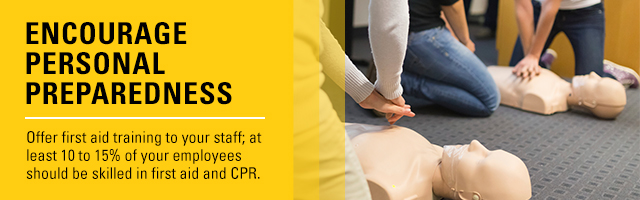
You should also encourage employees to consider alternative routes when entering and exiting the facility, and keep emergency preparedness kits at work. Remind employees to keep emergency contact information current.
Additional Resources
Be sure to review emergency plans annually, since preparedness needs do change. You can obtain up-to-date information from:
- American Red Cross — For assistance in assessing the emergency preparedness of your business, you might consider the American Red Cross Reading Rating, a 1-2-3-point self-assessment of preparedness to reveal areas for improvement.
- Ready.gov — This site offers a sample business emergency plan, along with advice on how to build disaster kits and prepare for emergencies.
- FEMA — FEMA also provides resources on emergency preparedness in addition to disaster specific information.
- Small Business Administration — If you’re a small-business owner, the Small Business Administration offers tips on preparing for disaster and other helpful information. The SBA has a disaster recovery loan program to provide capital to get through the recovery process.
- OSHA — You can access an eTool to help small, low-hazard services and retail businesses implement emergency action plans.
Contact Us Today for Help With Your Emergency Response Plan
Whether you’re working on a small-business emergency response plan, or you’re a large corporation, Warren CAT can help. Contact us today for assistance developing your plan.